Nearly every growing business hits the same fork: keep paying for off-the-shelf software that almost fits, or build something bespoke that fits exactly. Vendors on both sides will tell you they're the obvious answer. They're not — the right choice depends on your situation, and it's easier to get right than the sales noise suggests.
It's not really about the upfront price
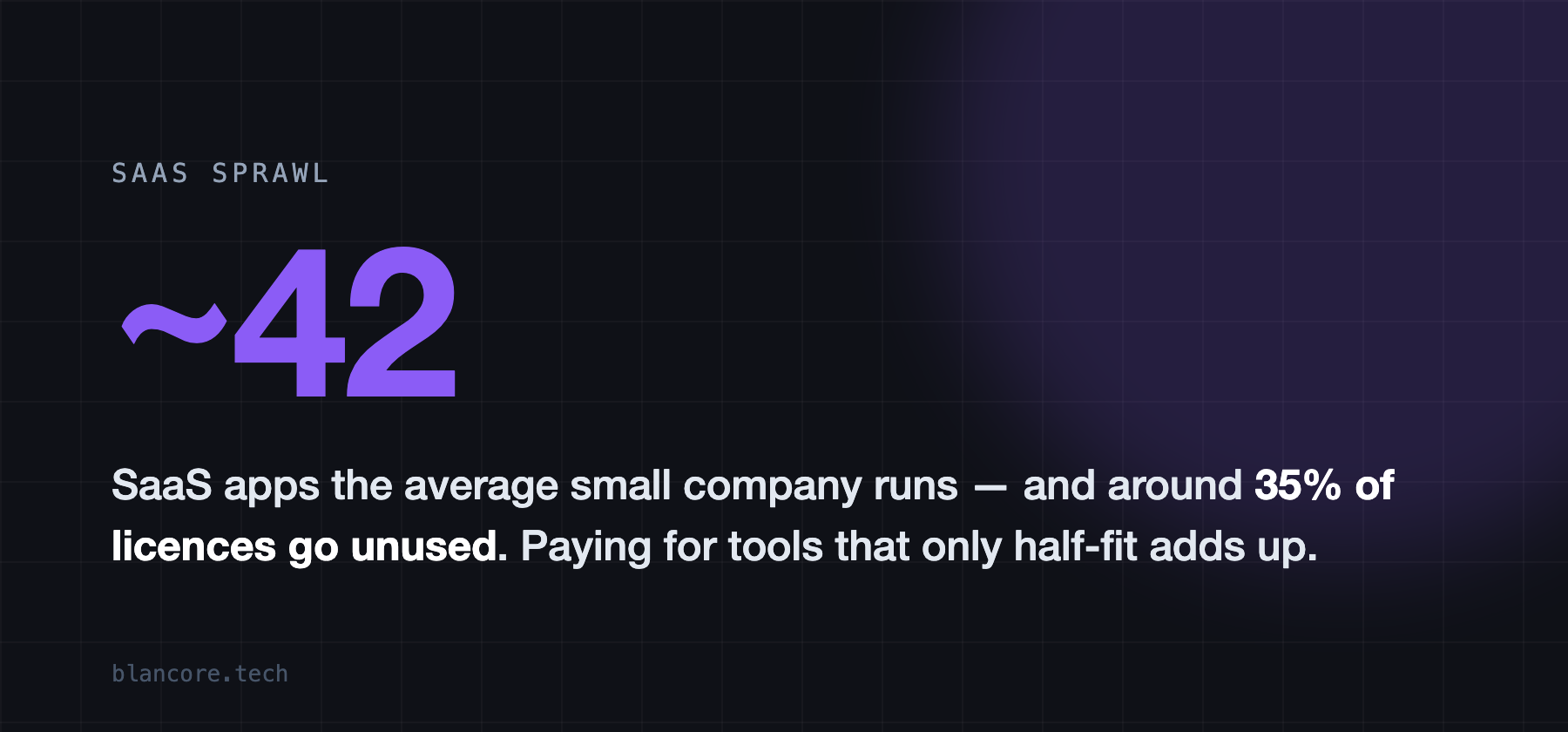
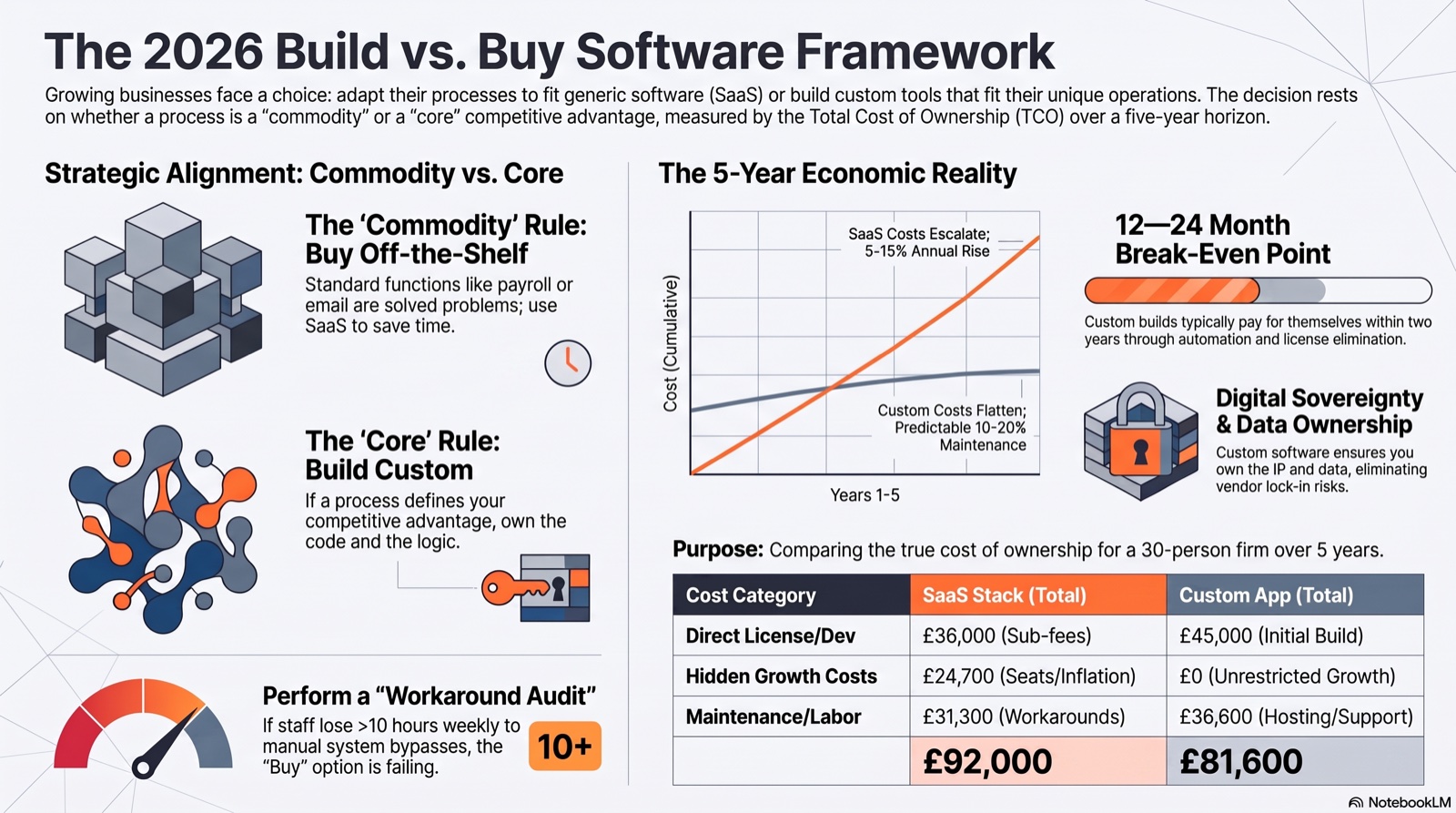
Off-the-shelf (SaaS) software looks cheaper because you compare a monthly subscription to a one-off build cost. But that's the wrong comparison. The honest one is total cost of ownership over three to five years — and once you add up per-seat licences as you grow, paid add-ons for the features you actually need, and the staff hours spent working around the bits that don't fit, the picture changes.
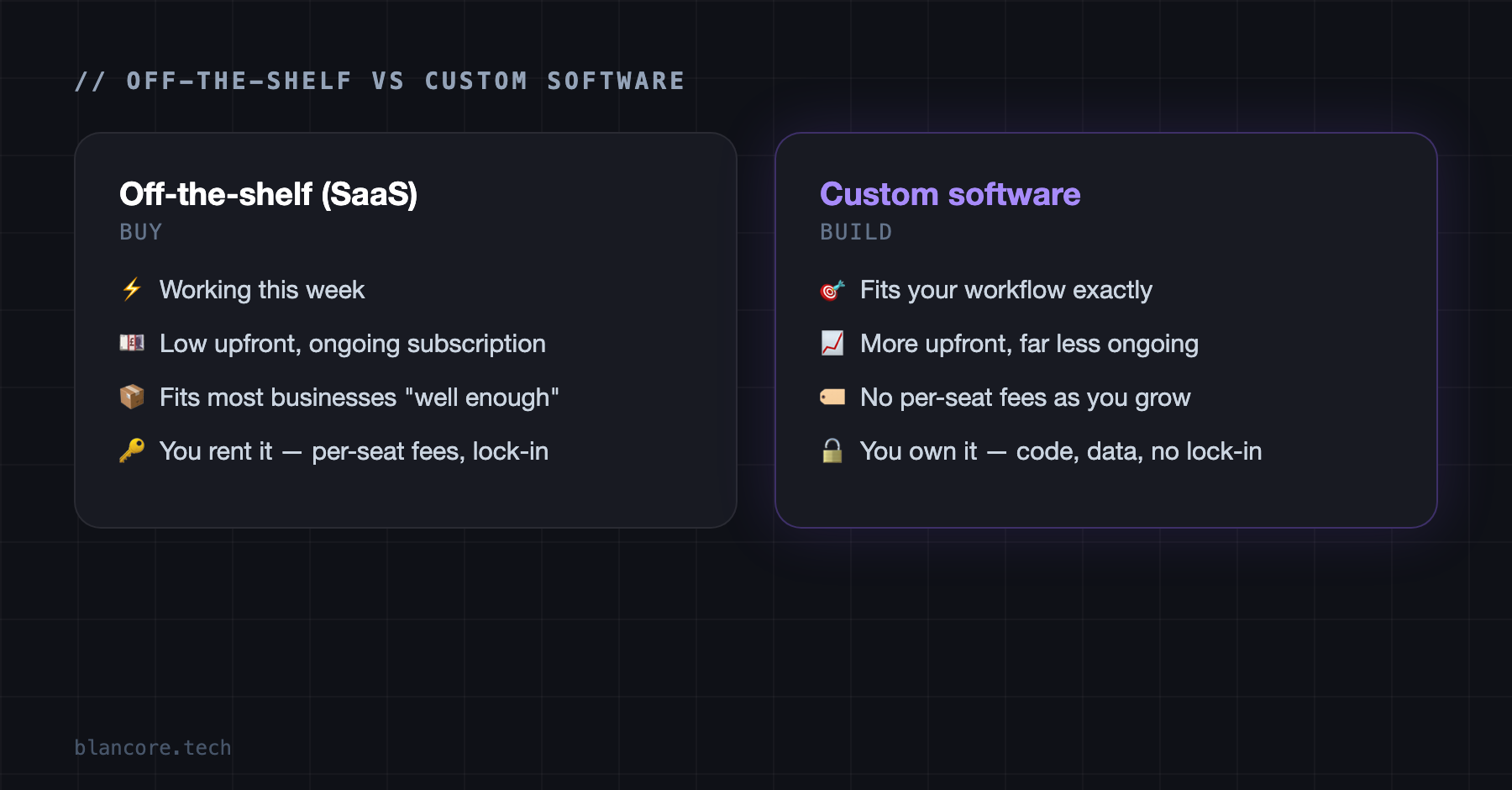
Custom software flips the shape of the cost: more upfront, then far less ongoing — no per-seat fees, no paying for modules you'll never use, and no manual workarounds. Whether that maths favours build or buy depends entirely on your scale and how well the off-the-shelf option actually fits.
When off-the-shelf is the right call
Buy, don't build, when your need is common and well-served. Email, accounting, basic CRM, payroll — these are solved problems with excellent, cheap, reliable tools. If a product fits your process closely enough and you want it working this week, off-the-shelf wins easily. Rebuilding a commodity tool to save a subscription is almost always a false economy.
When custom is worth it
Building becomes the smarter investment when:
- Your workflow is a differentiator. If the way you operate is part of why customers choose you, forcing it into a generic tool erodes the very thing that sets you apart.
- You're paying for scale you don't use. Lots of seats, or expensive tiers unlocked just for one feature, is a classic signal that a bespoke tool would pay for itself.
- You're stitching tools together by hand. If staff copy data between three systems all day, the "cheap" tools are costing you a fortune in time — often better spent on one fitted system (or proper integration).
- No vendor offers it. Sometimes the thing you need simply doesn't exist off the shelf.
The answer is usually "both"
The best setups rarely choose one side. They buy off-the-shelf for the commodity parts, build custom for the bit that's uniquely theirs, and integrate the two so data flows between them.
You don't need a bespoke accounting package — buy Xero or Sage. But the workflow that makes your business special might deserve a custom tool that then talks to that accounting package. That hybrid is usually the cheapest effective answer, and increasingly it's where AI slots in too — automating the judgement-light steps inside a system built around how you actually work.
Two things to nail down before you build
Ownership. With a good partner, custom software is an asset you own outright — the code, the data, the infrastructure — with no lock-in. Confirm that in the contract before anyone starts; ambiguous IP terms are the main way "bespoke" turns into a different kind of vendor trap.
Scope. Custom doesn't have to mean a huge upfront gamble. A good build is staged and fixed-price per stage, so you see value early and control the spend — the same discipline we describe in what it costs to build an app.
A quick way to decide
Ask three questions. Is this need common and well-served? (If yes, lean buy.) Is this workflow a genuine differentiator, or are we paying a lot to work around a tool that half-fits? (If yes, lean build.) Could we buy the commodity part and build only the unique part? (Usually yes — and usually best.) If you're still unsure, that's exactly the conversation a good custom software partner should have with you honestly, before selling you anything.
Sources & further reading
SaaS-usage figures are from widely-reported industry surveys; cost comparisons reflect typical total-cost-of-ownership patterns and are indicative — your figures depend on seat counts, tiers and fit. For handling data when building or integrating systems, see the ICO.
Frequently asked questions
Keep reading
Have a project in mind?
Tell us what you're trying to solve and we'll come back within 24 hours — no hard sell.
Start a Conversation