"How much does an app cost?" is the software equivalent of "how much does a building cost?" — the honest answer is it depends, but that's no use when you're trying to budget. So here's the useful version: realistic 2026 price bands for building an app in the UK, exactly what pushes the number up or down, and how to spend less without ending up with something you regret.
Want a number for your own app? Our free App Cost Calculator turns the bands below into a cost range and timeline for your specific feature list — no signup.
The short answer, in bands
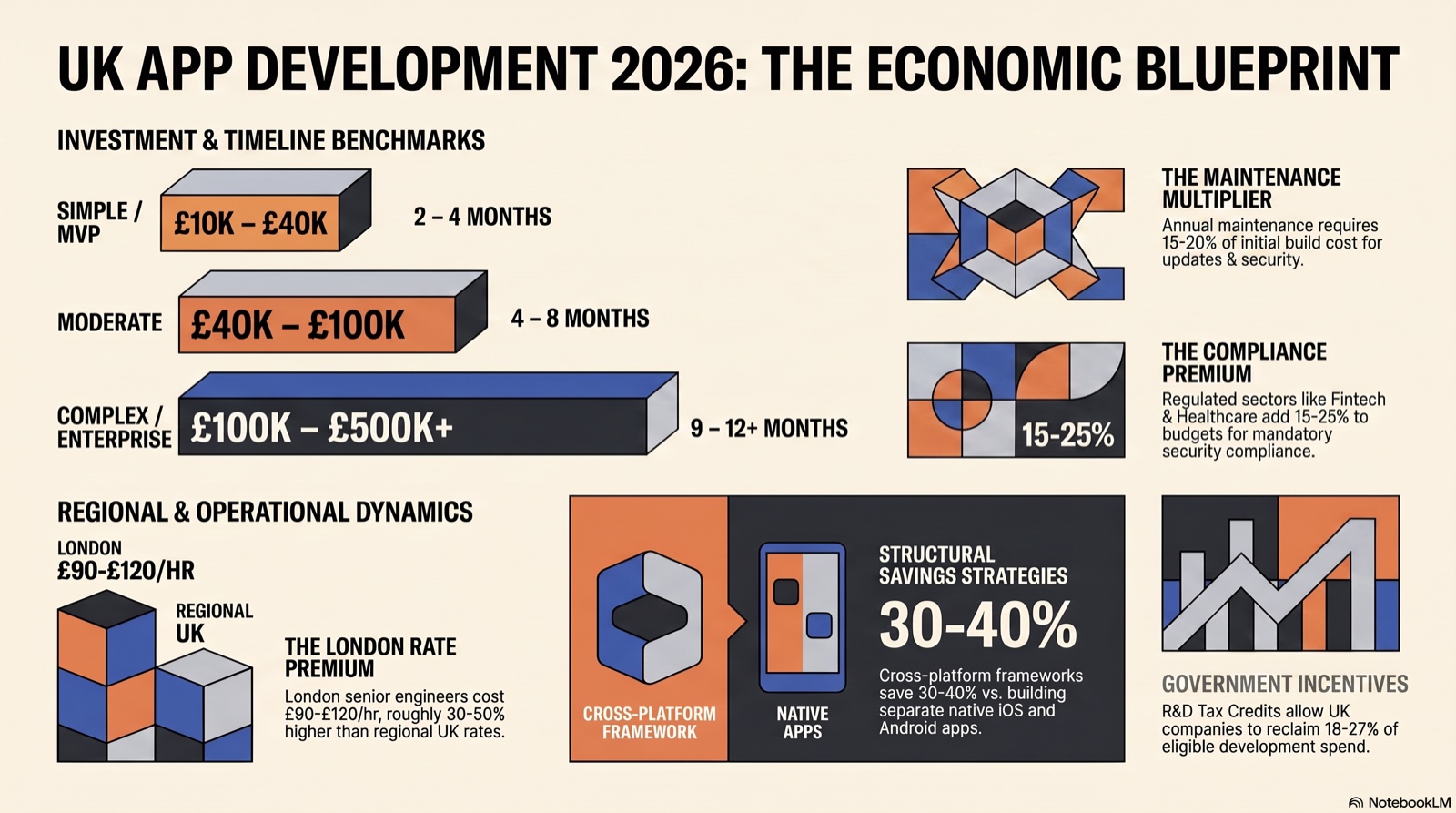
Rather than a single figure, think in tiers. A simple app — one platform, a handful of screens, no complex backend — starts in the low tens of thousands of pounds. A mid-complexity app — user accounts, payments, a backend, both iOS and Android — sits meaningfully higher. A complex product — custom features, real-time data, third-party integrations, polished design — costs more again, and a genuine platform can run into six figures.
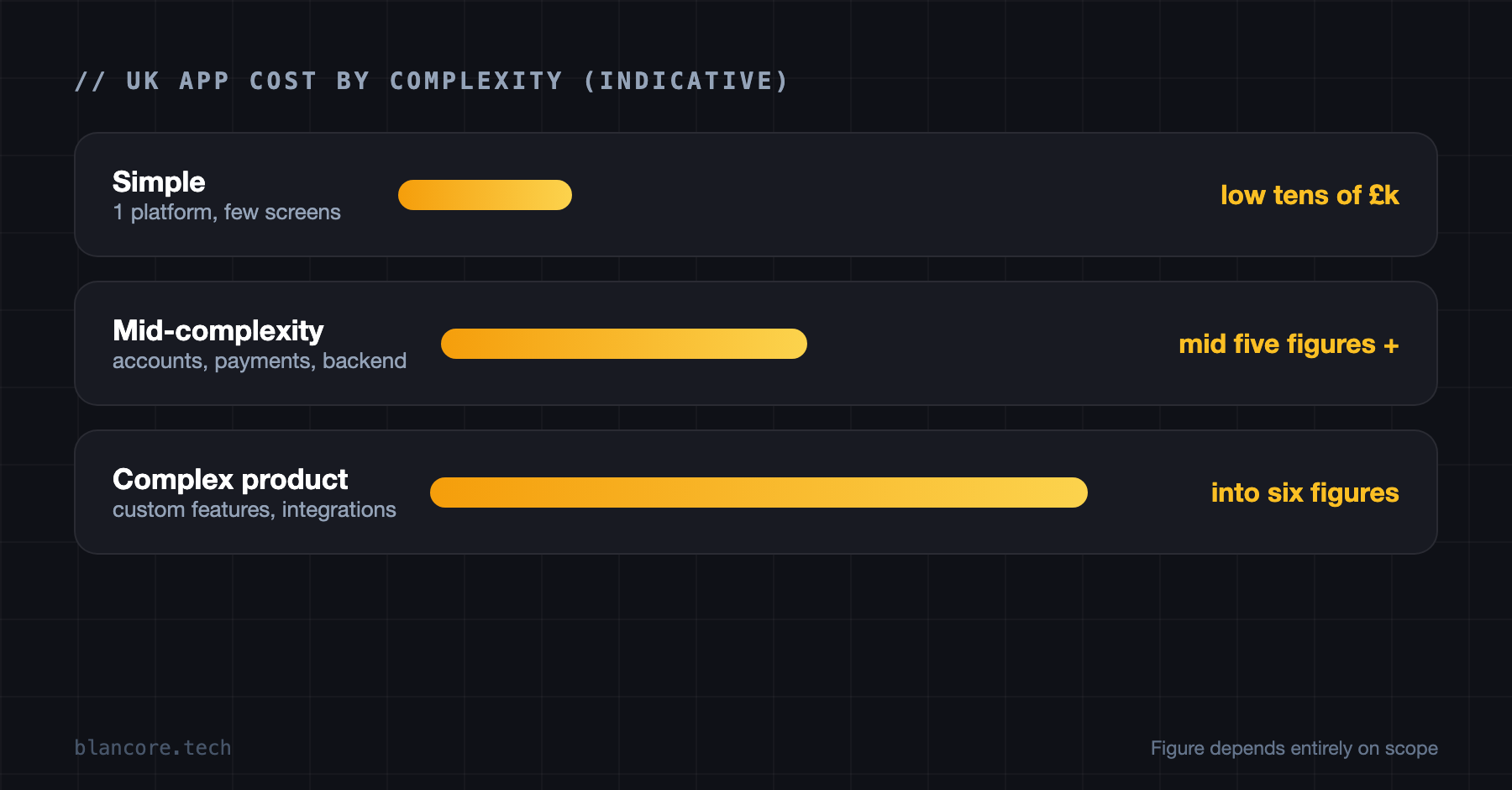
The wide range isn't vagueness — it reflects how different "an app" can be. The job is to work out which band you're in, and the drivers below decide that.
What actually drives the cost
- Features. The single biggest lever. Every screen, every rule, every "can it also…" adds build and testing time. A tight feature list is the cheapest thing you can bring to the table.
- One platform or two. iOS and Android costs more than one — though cross-platform tools narrow the gap (more below).
- The backend. An app that just displays information is cheap; one that syncs data, handles accounts, and processes payments needs a server, a database, and security work behind it.
- Integrations. Connecting to payment providers, CRMs, or other systems adds cost — and is often where the real value is.
- Design. A functional interface is quicker than a distinctive, polished one. Both are valid; they cost differently.
- Who builds it. A UK agency, a freelancer, and an offshore team sit at very different price points — with real trade-offs in communication, reliability, and who's accountable when something breaks.
Native or cross-platform?
You don't usually need two separate apps. Cross-platform frameworks like React Native and Flutter let a single codebase run on both iOS and Android, which cuts cost and time versus building each one natively — with quality that's indistinguishable for most business apps. Native still earns its premium when you need heavy hardware access or top-tier performance (think games or complex camera work). For the vast majority of business apps, cross-platform is the sensible default. It's how we approach most builds on our app development service.
The cost people forget: after launch
An app isn't a one-off purchase; it's more like a vehicle. Buy it, then budget to run it.
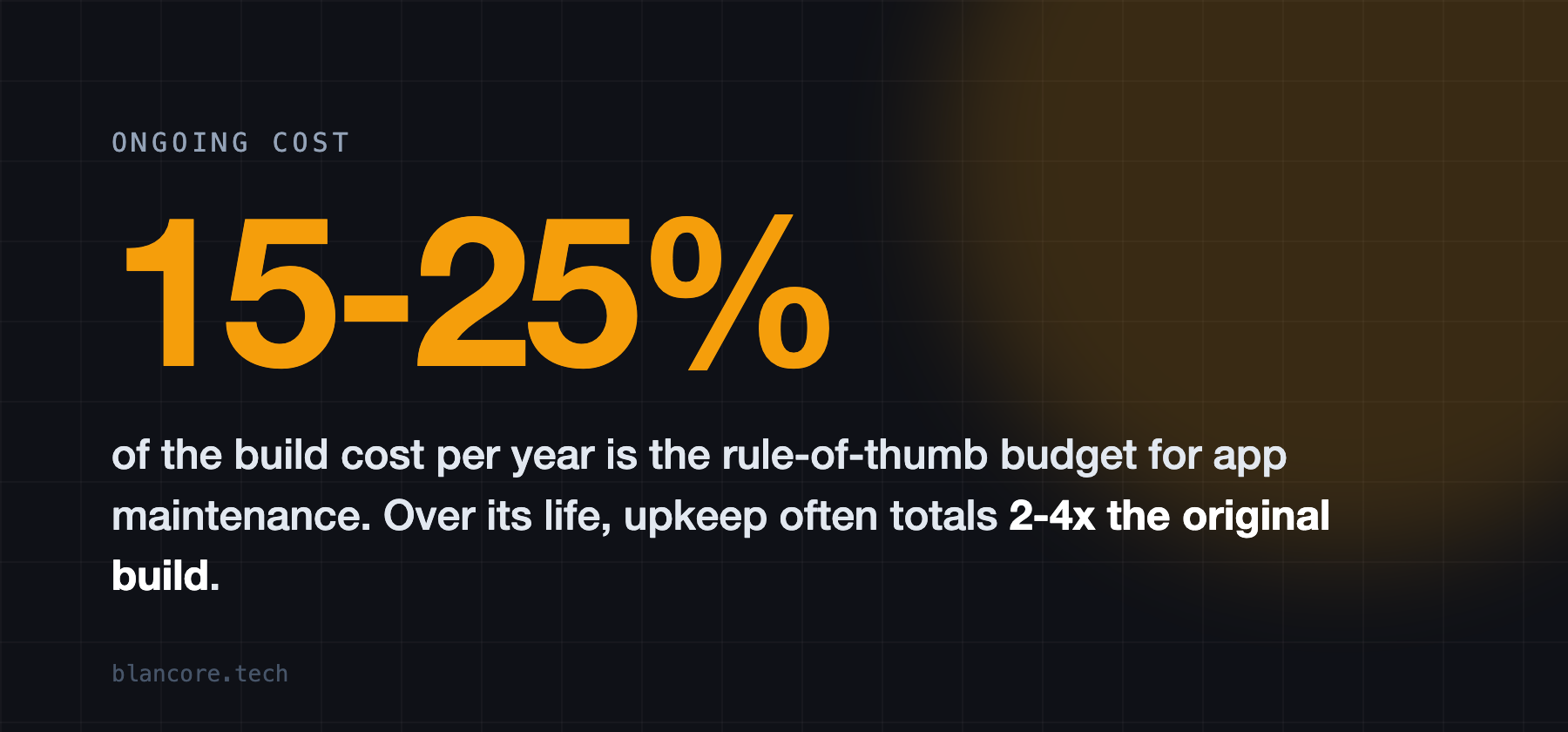
Operating systems update, security patches are needed, and users start asking for things. A sensible rule of thumb is to budget a meaningful percentage of the build cost each year for maintenance. Apps that launch and are then left alone tend to quietly break within a year or two — so factor upkeep in from the start, not as a surprise later.
How to spend less (without regret)
The most reliable way to overspend is to try to build everything at once. The opposite works far better:
- Start with an MVP — the smallest version that delivers real value to real users.
- Launch it and watch how people actually use it.
- Invest in what they ask for, not what you guessed they'd want.
This turns a big, risky bet into a series of small, informed ones. It's the same discipline we apply across all our custom software work, and it pairs naturally with the build-vs-buy question — sometimes the cheapest "app" is configuring something off-the-shelf, which we cover in custom software vs off-the-shelf.
A sensible next step
Before you ask anyone for a quote, write down the problem the app solves, the must-have features (be ruthless), and who it's for. That one page will get you a far more accurate estimate — and lets a good partner tell you honestly whether an app is even the right answer. When you're ready, a scoped, fixed-price proposal beats an open-ended day rate every time.
Sources & further reading
Cost bands reflect typical UK app-development pricing in 2026 and are indicative — your figure depends on scope. The 15–25% maintenance rule of thumb is a widely-cited industry benchmark. For an honest estimate, start from a written feature list.
Frequently asked questions
Keep reading
Have a project in mind?
Tell us what you're trying to solve and we'll come back within 24 hours — no hard sell.
Start a Conversation