"AI automation" gets used to mean almost anything. Stripped of the hype, it's simple: intelligent software that handles repetitive, time-consuming work with little human involvement — so your team can spend their hours on the things that actually need a person.
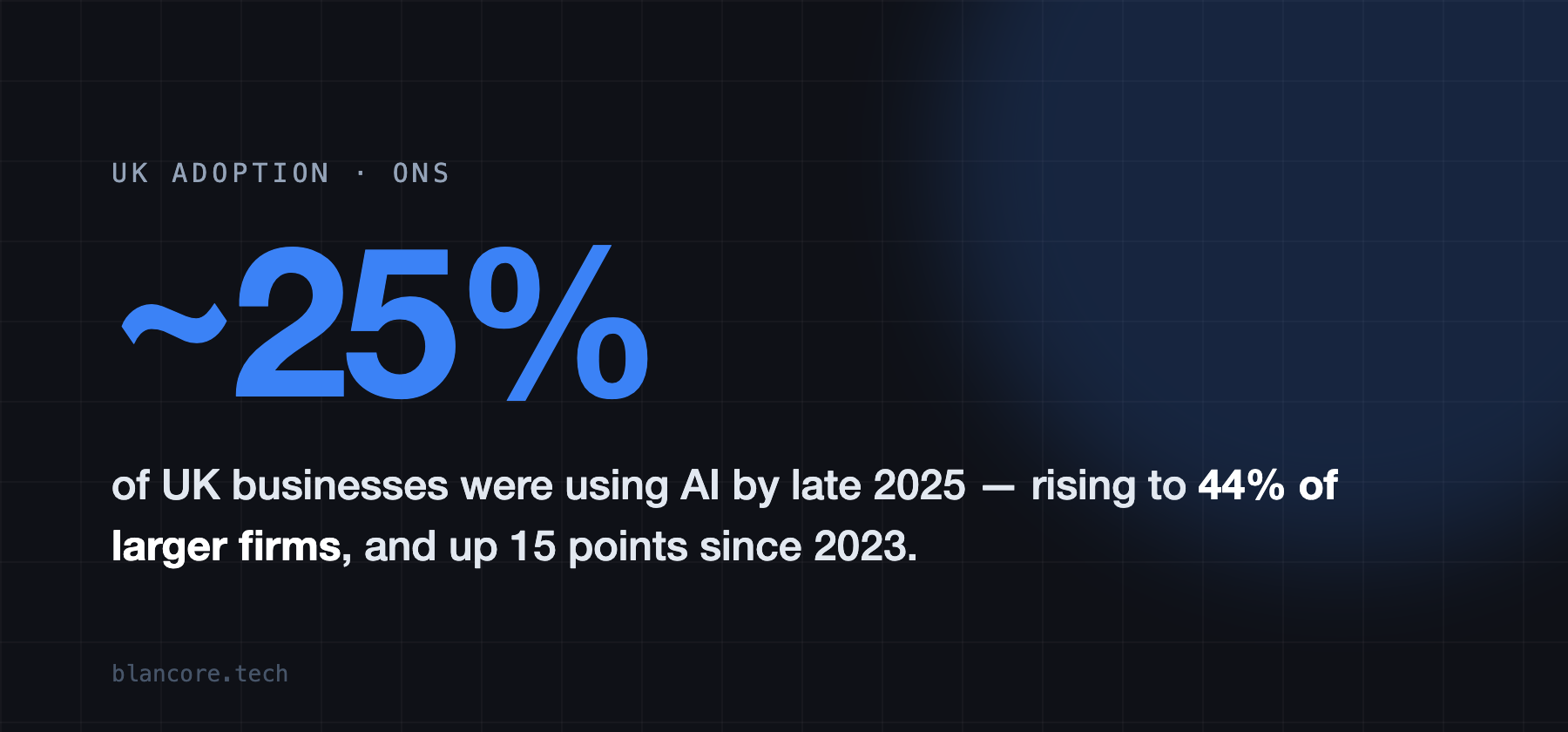
What's changed recently is adoption. According to the Office for National Statistics, around a quarter of all UK businesses were using AI by late 2025 — rising to 44% among larger firms — up roughly 15 percentage points in two years. It has moved from experiment to everyday tool remarkably fast. Here's what it actually is, how it differs from ordinary automation, and a dozen concrete ways UK companies are using it today.
Automation vs. AI automation: the brain and the hands
The clearest way to understand the difference is to think of traditional automation as the hands of a business and AI as the brain.
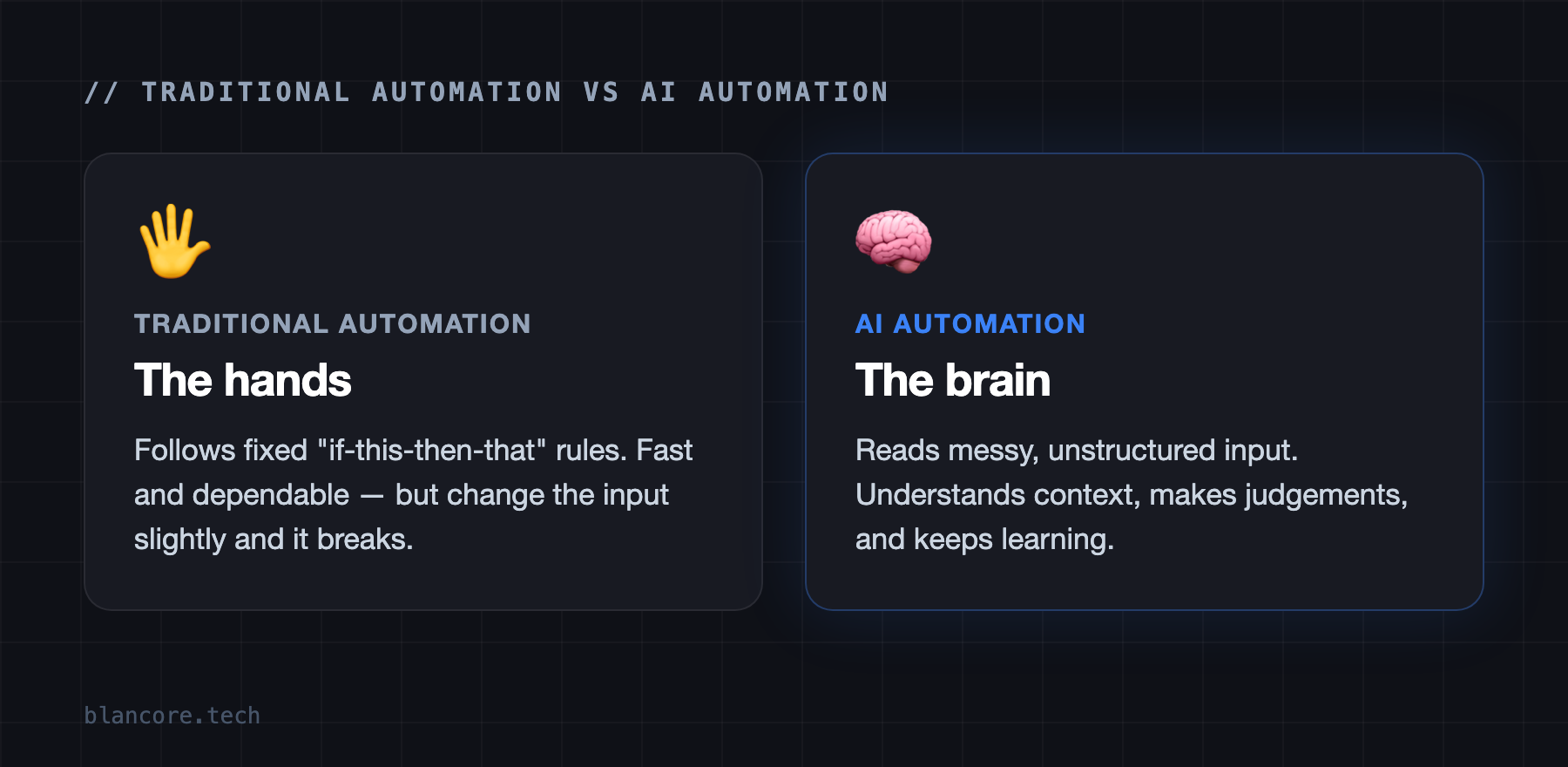
Traditional automation is strictly rule-based: "if this, then that." It's brilliant at moving data from a web form into a spreadsheet — but it can't cope with anything it wasn't explicitly programmed for. Change the input slightly and it breaks.
AI automation adds the ability to handle messy, unstructured, language-heavy work. Instead of just filing an email in a folder, an AI system can read the email, judge that the customer is unhappy, draft a suitable reply, and log the whole interaction in your CRM. It reads context and makes judgements — the parts rules alone never could.
12 real ways UK businesses use AI automation
Admin & HR
- Document processing. Pulling structured data out of contracts, purchase orders, and compliance forms — turning messy PDFs into clean records automatically.
- Meeting & CRM syncing. AI joins calls, transcribes them, extracts action items, and writes the notes straight into your CRM.
- Onboarding. Automating routine HR steps — right-to-work checks, answering new-starter policy questions — without tying up a manager.
Customer service
- First-line triage. AI resolves a large share of routine queries (delivery tracking, password resets) and gathers context before handing the tricky ones to a person.
- Live agent assist. "Copilots" that listen to a call or read a chat in real time and surface the right answer to your staff, cutting handling time.
- Sentiment triage. Scanning incoming tickets for frustration or urgency and pushing the high-risk ones to the top of the queue.
Sales & marketing
- Lead qualification. Reading new enquiries, scoring them against your ideal customer, and booking qualified prospects straight into the calendar.
- Personalised outreach. Drafting tailored follow-ups that adapt to how a prospect responded, instead of generic blasts.
- Cart recovery. Generating genuinely personalised abandoned-basket emails based on what the shopper actually browsed.
Finance & operations
- Invoice automation. Reading supplier invoices from the inbox, extracting line items and VAT, and drafting a bill in software like Xero for approval.
- Cash-flow forecasting. Using your transaction history to project cash position weeks ahead, so short-term gaps don't surprise you.
- Anomaly detection. Continuously checking your numbers against a learned baseline to flag duplicate invoices or unusual activity instantly.
And on the phone
One of the fastest-moving areas is voice: AI phone agents that answer every call around the clock, qualify the caller, and book appointments — the same "read, judge, act, log" pattern, applied to a phone line. You can hear a live one for yourself before deciding whether it fits.
Does it actually pay off?
The numbers reported by UK adopters are consistently strong. Small and medium businesses commonly report 40–60% time savings on the repetitive tasks they automate — a job that took ten hours a week routinely dropping to four to six. Well-scoped projects typically reach payback within three to six months. And despite the fear of job losses, official ONS figures show only around 4% of AI-using UK businesses have cut headcount as a result — the rest redeploy people to higher-value work rather than replacing them.
The businesses that win with AI automation don't automate everything. They pick one high-friction, repetitive task, prove it saved time or money, and expand from there.
Where to start
You don't need a data team — you need one well-chosen task and a reliable implementation. Often the data you already have (the emails in your inbox, the records in your CRM) is enough to begin. If you'd like a hand spotting the right first task, that's exactly what our AI solutions and integration work is for — and our companion guide, how to automate your business with AI, lays out the step-by-step process.
Sources & further reading
Official adoption figures come from the ONS; time-saving and payback ranges reflect industry surveys and should be read as indicative rather than guaranteed for any one business.
- ONS — Business insights and impact on the UK economy (UK AI adoption and workforce data)
- GOV.UK — AI adoption research
- ICO — Artificial intelligence and data protection
Frequently asked questions
Keep reading
Have a project in mind?
Tell us what you're trying to solve and we'll come back within 24 hours — no hard sell.
Start a Conversation