
Most AI automation projects that fail don't fail because of the technology. They fail because someone bought a tool before they understood the problem. This is the opposite approach: a practical, ordered process for automating a real business process with AI — one that keeps risk low and makes the value obvious before you spend big.
It works for a one-person operation or a hundred-person firm. The principle is the same: pick one task, prove it, then scale.
The six-step process
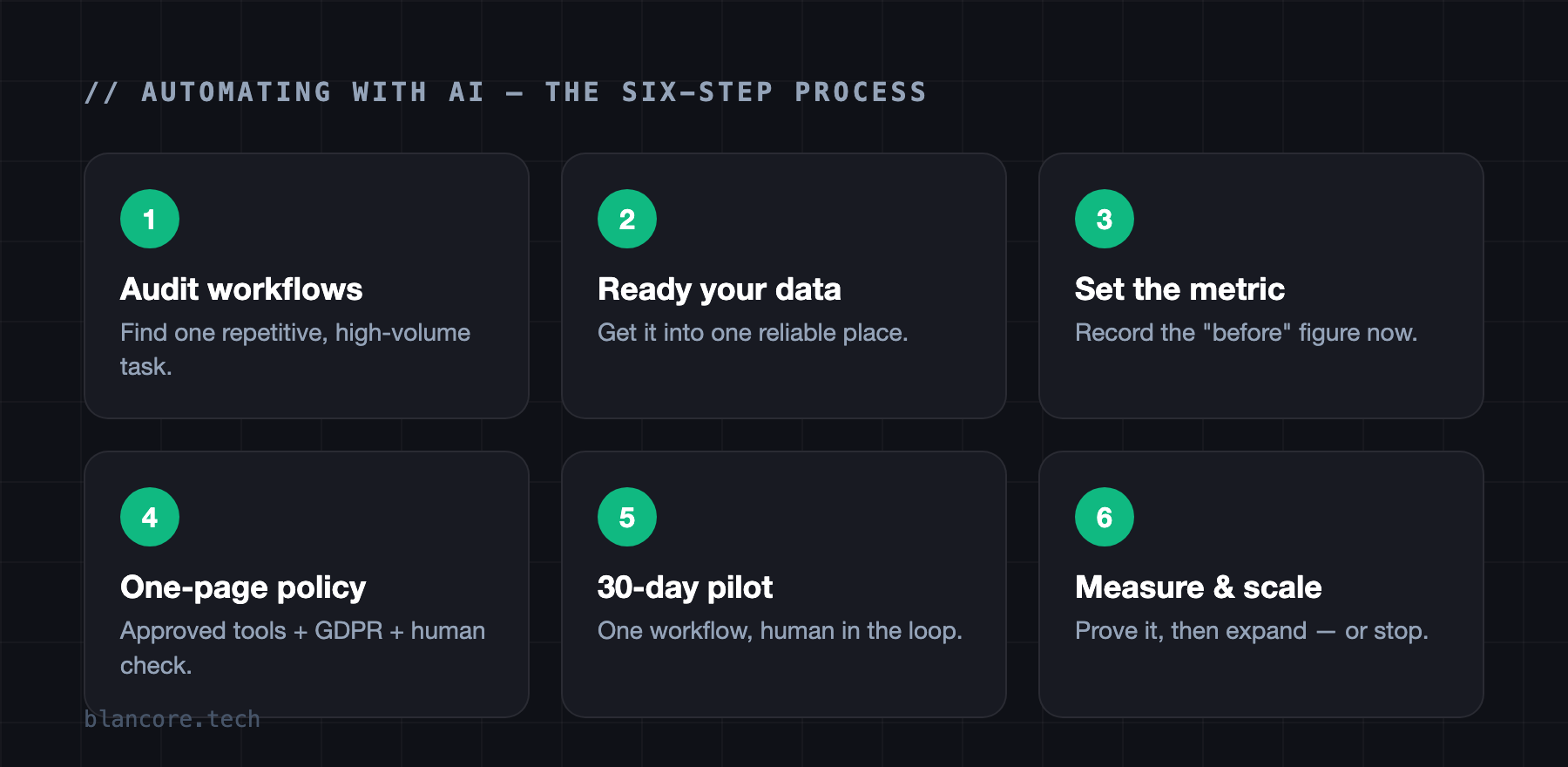
1. Audit your workflows before you choose a tool
Start by mapping what your team actually does each week and finding the tasks that are repetitive, high-volume, and don't need much human judgement. Frame it as a specific problem — "we spend fifteen hours a week keying in invoices" — not a vague ambition to "use AI". The specific problem is what you'll measure success against later.
2. Check your data is ready
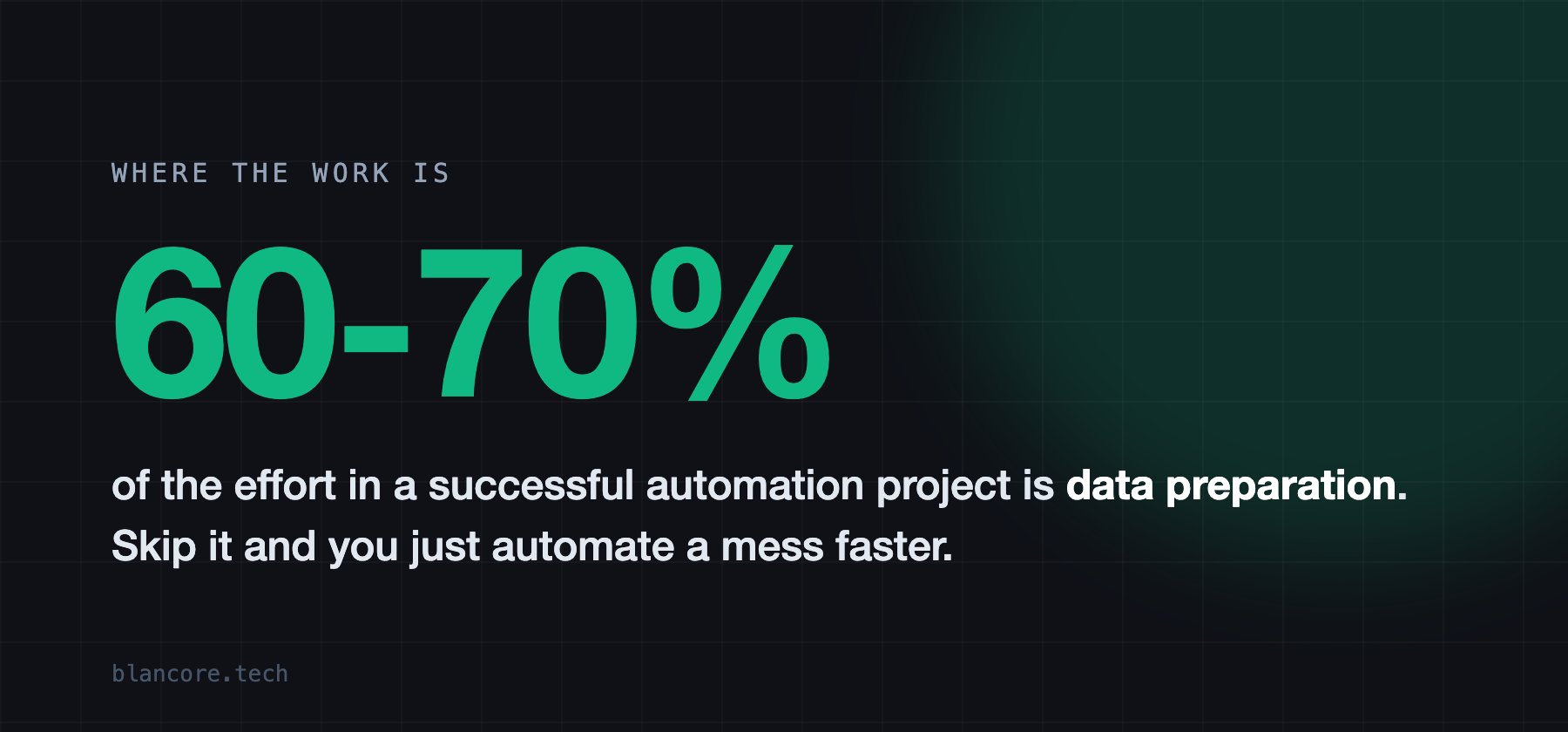
AI needs reasonably clean, structured data to work. Before automating, make sure the records the task depends on live in one reliable place rather than scattered across inboxes and spreadsheets. This step is unglamorous but decisive: in real projects, data preparation routinely accounts for 60–70% of the total effort. Skip it and you'll simply automate a mess faster.
3. Decide how you'll measure success — up front
Write down the metric before you build: hours saved per week, error rate, response time, conversion. Capture the "before" figure now, while the task is still manual, so you have something honest to compare against. If AI phone handling is the target, our missed-call cost calculator gives you a baseline in minutes.
4. Set a light-touch AI usage policy
You don't need a thick governance manual — a single page will do. Cover which tools are approved, what data may and may not be entered into them, and where a human stays in the loop. Make sure your chosen tools comply with UK GDPR, particularly around where data is processed and stored. Getting this right early is far cheaper than retrofitting it.
5. Run a tightly-scoped 30-day pilot
Pick one high-impact, low-risk workflow and build a minimum viable version. Keep a human checking every AI output before it goes anywhere external. A short, bounded pilot does two things: it proves the value on your real data, and it contains the downside if the fit isn't right.
6. Measure, review, and scale gradually
Compare the pilot against your baseline and ask the people using it what they honestly think. If it hit the metric, expand it — to more volume, then to adjacent tasks. If it didn't deliver inside the 30 days, have the discipline to stop and try a different task. A clear "kill criterion" is a feature, not a failure.
The mistakes that sink automation projects
Almost every failed project we've seen traces back to one of these:
- Chasing shiny objects. Buying AI because of a flashy demo or fear of missing out, rather than to solve a concrete bottleneck.
- Automating a broken process. If the underlying process is inefficient or the data is dirty, AI just produces flawed output faster. Fix the process first.
- Doing everything at once. Trying to automate ten things simultaneously leads to complexity, misconfiguration, and abandonment. One task at a time.
- Ignoring the people. Build automation in secret and your team will fear replacement and quietly resist it. Involve them; show them it removes the work they dislike.
- Tool fragmentation. Buying disconnected tools that don't talk to each other just moves the manual copy-paste around. Integration with your existing CRM or finance system matters more than any single tool's features — it's the whole point of proper web and systems integration.
- Set-and-forget. Models change and connections break. Budget a few hours a month for upkeep, or your automation will silently stop working within months.
Applying AI to a broken process doesn't fix the process. It just executes the bad version faster — and now it's harder to see.
What "good" looks like
A healthy first automation is small, measurable, integrated into a tool you already use, and owned by a named person who watches the numbers. Within a month you should be able to point to a real before-and-after. That's the pattern our AI solutions work follows on every engagement: a scoped pilot before any big commitment, so the value is proven, not promised.
If you're still deciding what to automate, our companion piece — what is AI automation, with 12 real UK use cases — is a good place to find your first candidate.
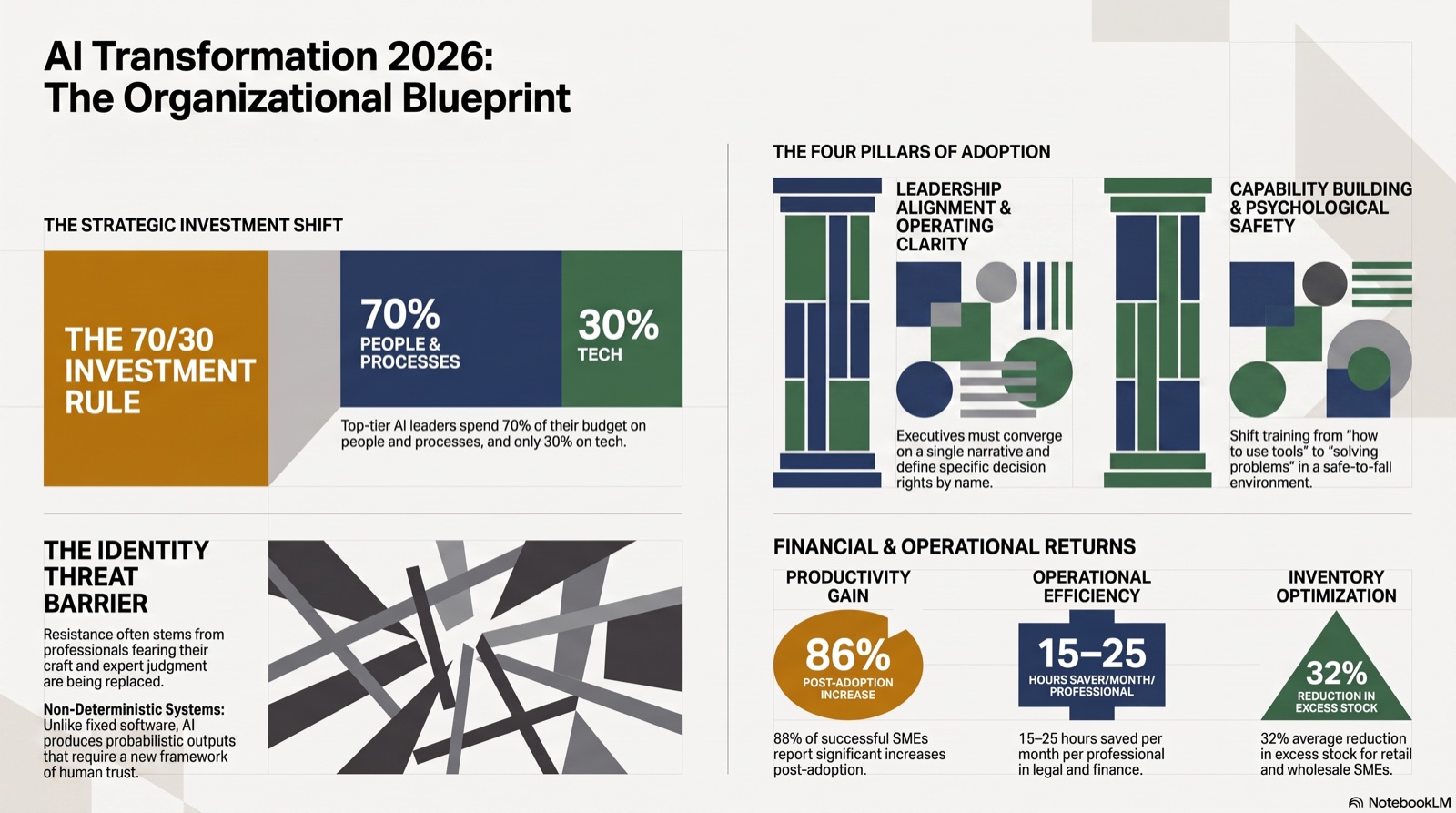
Sources & further reading
Effort and success-rate figures reflect industry analyses of automation projects and are indicative. Confirm current obligations for your sector before acting.
Frequently asked questions
Keep reading
Have a project in mind?
Tell us what you're trying to solve and we'll come back within 24 hours — no hard sell.
Start a Conversation