These three words get used as if they mean the same thing. They don't — and buying the wrong one is the most expensive mistake we see UK businesses make with AI. A chatbot talks. An AI agent talks and then does something. Automation does something without talking at all. Here is how to tell which one your business actually needs, in plain English.
The three of them, in one sentence each
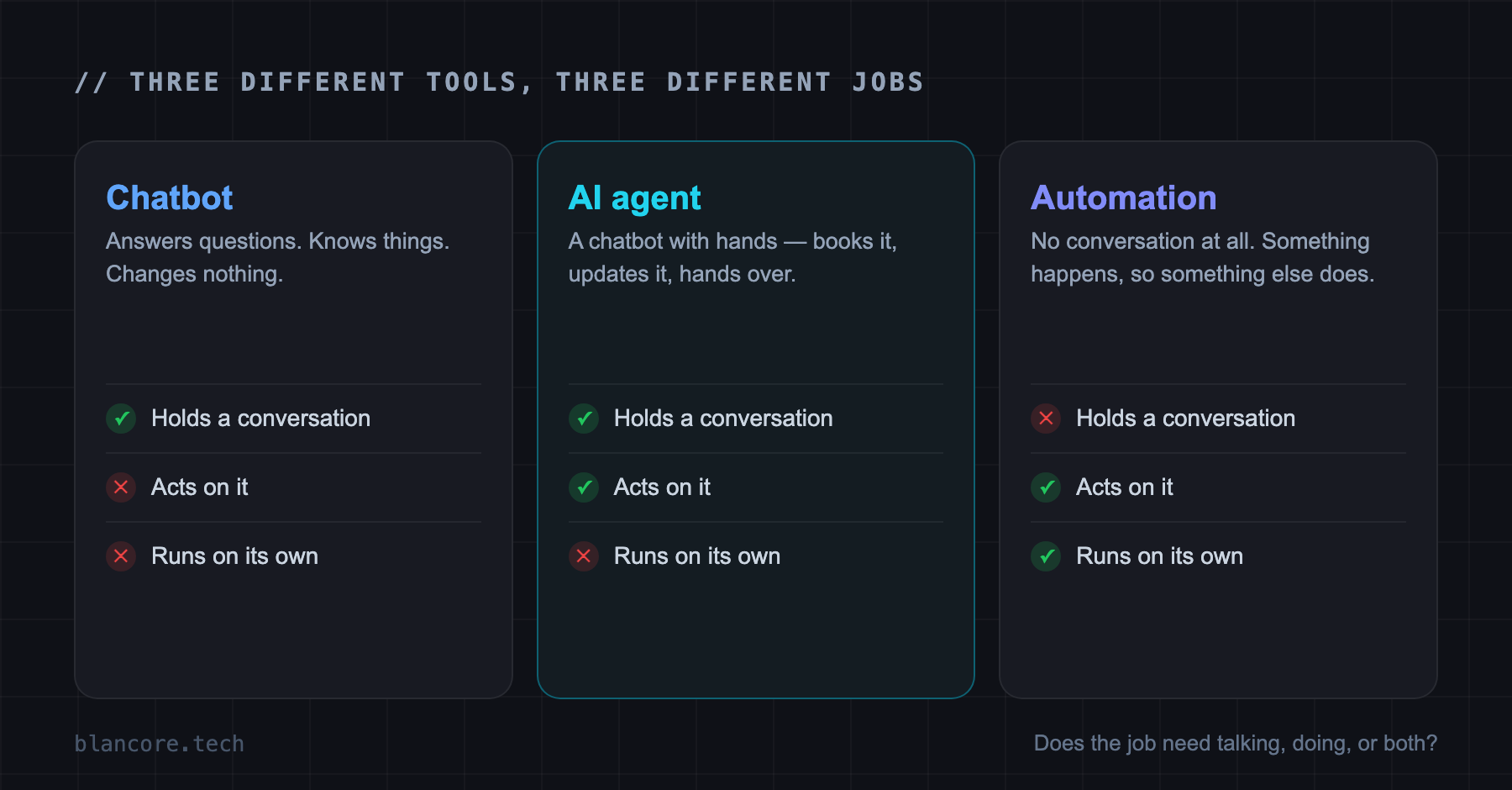
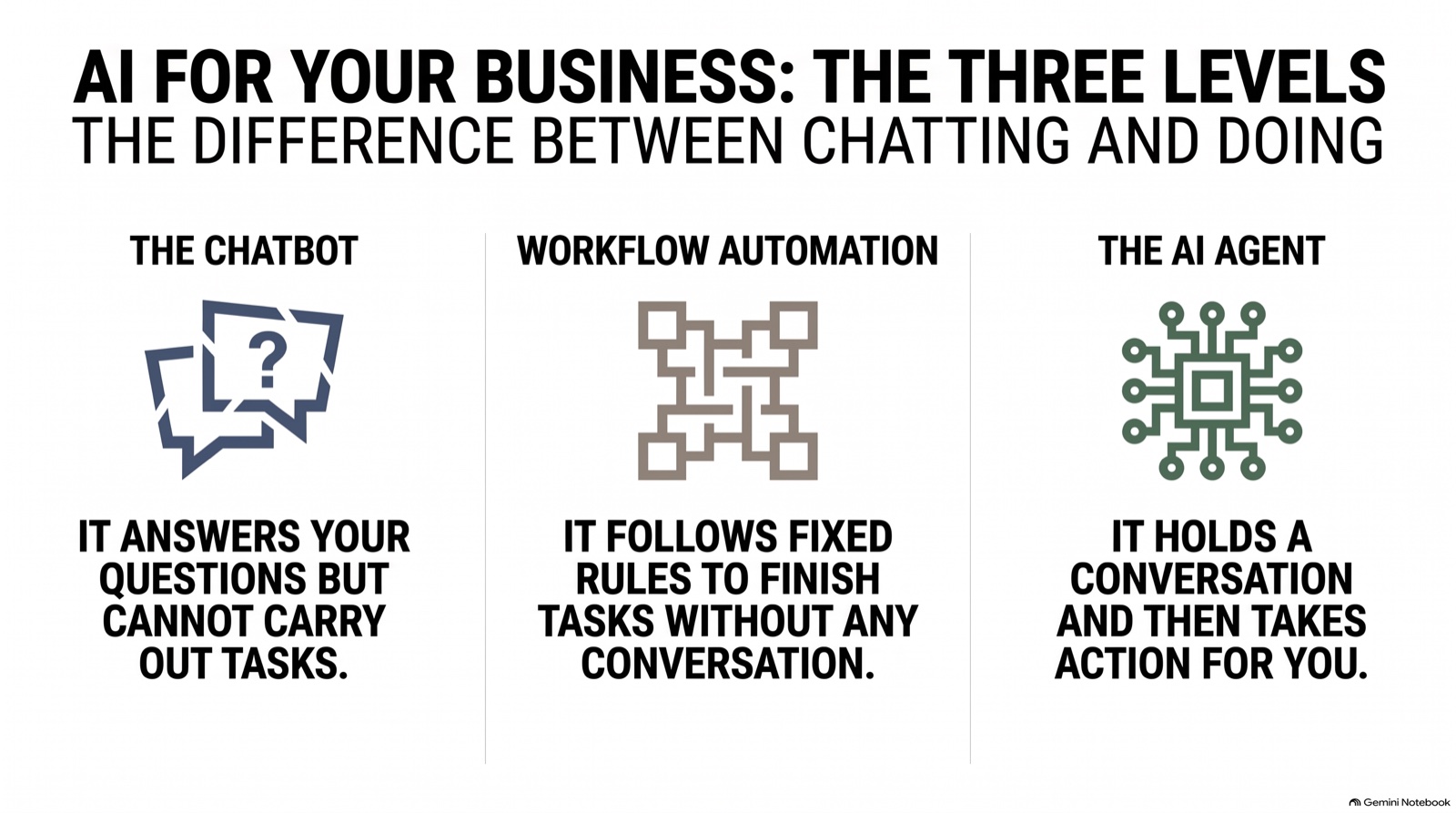
- Chatbot — answers questions in a conversation. It knows things. It doesn't change anything.
- AI agent — has the conversation and acts on it: books the slot, updates the record, passes the awkward one to a person.
- Automation — no conversation at all. Something happens, so something else happens, every time, without anyone asking.
Almost every argument about which to buy dissolves once you decide whether the job needs talking, doing, or both.
A chatbot talks — that's the whole job
A chatbot sits on your website or WhatsApp and answers questions from what it has been told: your opening hours, your prices, whether you cover Sutton Coldfield, what your returns policy says. Modern ones are genuinely good at this, and they are the cheapest of the three to run.
The limit is hard, though, and it catches people out. A chatbot can tell a customer that you have a slot on Thursday. It cannot book Thursday. The moment you want the conversation to change something in your business, you have stopped describing a chatbot.
An AI agent talks and then does something
An agent is a chatbot with hands. It holds the same conversation, but it is connected to your calendar, your CRM, your order system — so when the caller says "Thursday works", the appointment appears. When they say "actually, cancel it", it goes. And when the conversation turns into something it shouldn't be handling on its own, a well-built agent passes it to a person instead of bluffing.
That last part matters more than the clever bits. We cover what an agent is and isn't in more depth in our plain-English guide to AI agents. If the conversations in question are phone calls, that is a specific kind of agent — see AI phone agents.
Automation doesn't talk at all
Automation is the oldest and least glamorous of the three, and it is very often the right answer. An order comes in, so the customer record is created, the invoice is raised and the warehouse is told. Nobody had a conversation. Nothing needed to understand anything. It just happens, identically, every time.
Because there is no AI in the middle guessing at anything, automation is cheaper, faster and far more predictable. If a job can be described as a rule — "when X happens, do Y" — then putting AI in front of it usually adds cost and removes certainty. Our guide to AI automation for UK business goes into where the line sits.
So which one do you need?
Have a play with this. Answer honestly — the interesting result is when two of them come out close, because that is usually the truth.
Which of the three fits your business?
Answer five questions and watch the bars move. Nothing is sent anywhere — this runs entirely in your browser.
You need something that can hold a conversation and act on it. That is an agent's job, not a chatbot's.
A rough guide, not a recommendation. Plenty of businesses end up running two of the three side by side.
The mistake that costs the most
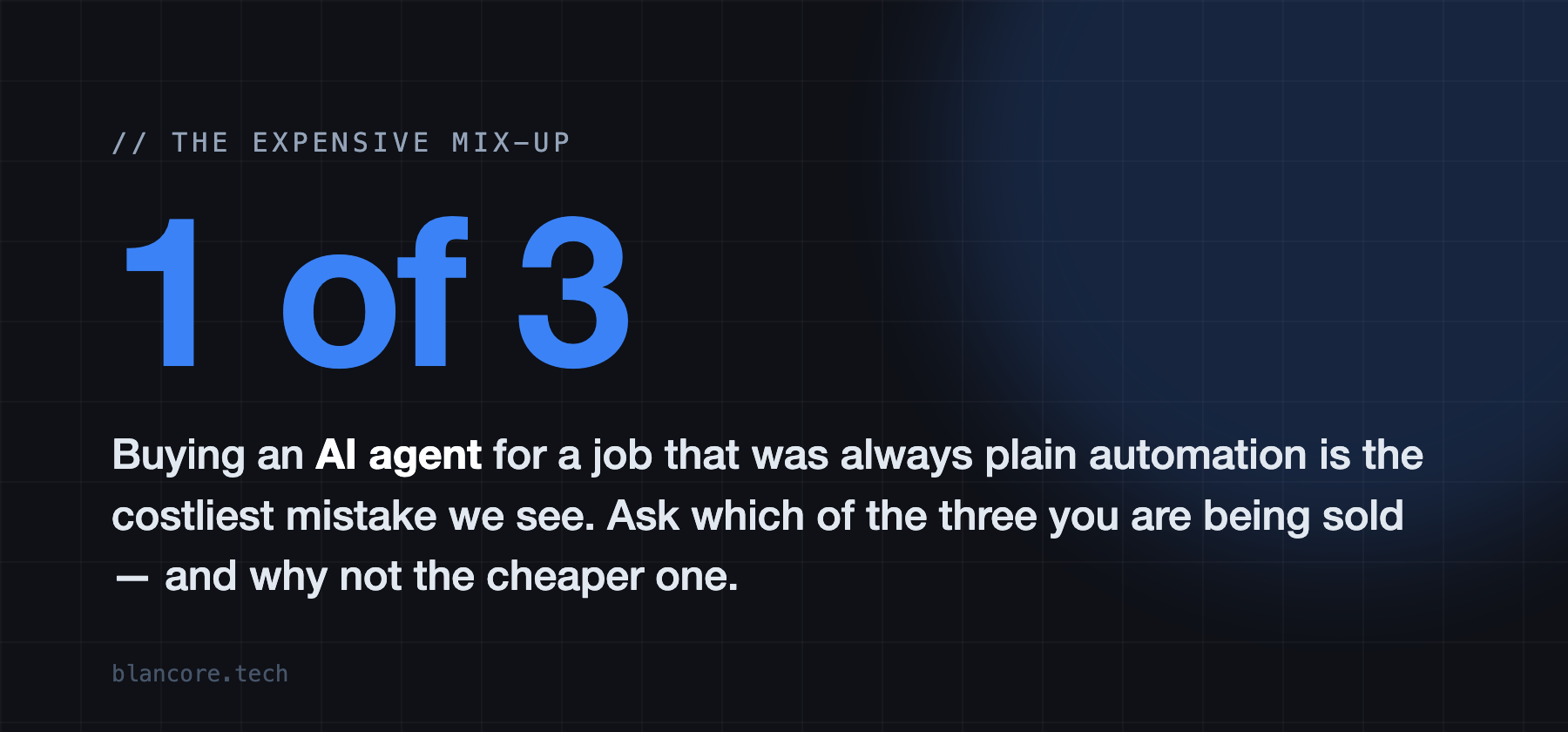
It is buying an AI agent for a job that was always plain automation.
It happens because the sales conversation is more exciting. "An AI agent that manages your invoicing" sounds like the future; "a connection between your order system and Xero" sounds like plumbing. But the second one is what chasing an invoice actually is, and it will run for years without surprising you. The first will cost several times as much and occasionally do something strange at two in the morning.
Ask any prospective supplier which of the three they are proposing, and why not the cheaper one. If they can't answer that clearly, that tells you something.
The reverse mistake is rarer but real: trying to force a genuine conversation into rigid automation, and ending up with the "press 1 for sales" experience everyone hates. If a person needs to be understood rather than processed, you need an agent.
Most businesses end up with two of the three
This is not really a competition. A typical setup we build has an agent answering the phone and the website, and plain automation quietly moving data between the systems behind it — because those are two different jobs. The point of choosing carefully is not to pick a winner; it is to avoid paying agent prices for automation work.
Start with the single job that costs you most, pick the simplest of the three that can do it, and prove it works before you extend. If you want a hand working out which is which, that is what our AI solutions work starts with — and if the answer turns out to be plumbing rather than AI, systems integration is the honest recommendation and we will say so.
Sources & further reading
The relative costs described here reflect current UK practice and are indicative — confirm them against quotes for your own situation. The scoring in the tool above is our own rule of thumb from UK SME projects, not measured data.
Frequently asked questions
Keep reading
Have a project in mind?
Tell us what you're trying to solve and we'll come back within 24 hours — no hard sell.
Start a Conversation