AI can help your small business by taking over the repetitive work that eats your team's time — answering calls, sorting emails, drafting replies, chasing invoices, spotting patterns in your numbers — so people are freed for the work that actually needs them. Below are ten concrete, proven ways UK small businesses are using it right now, and how to choose where to start.
10 practical ways AI can help your small business
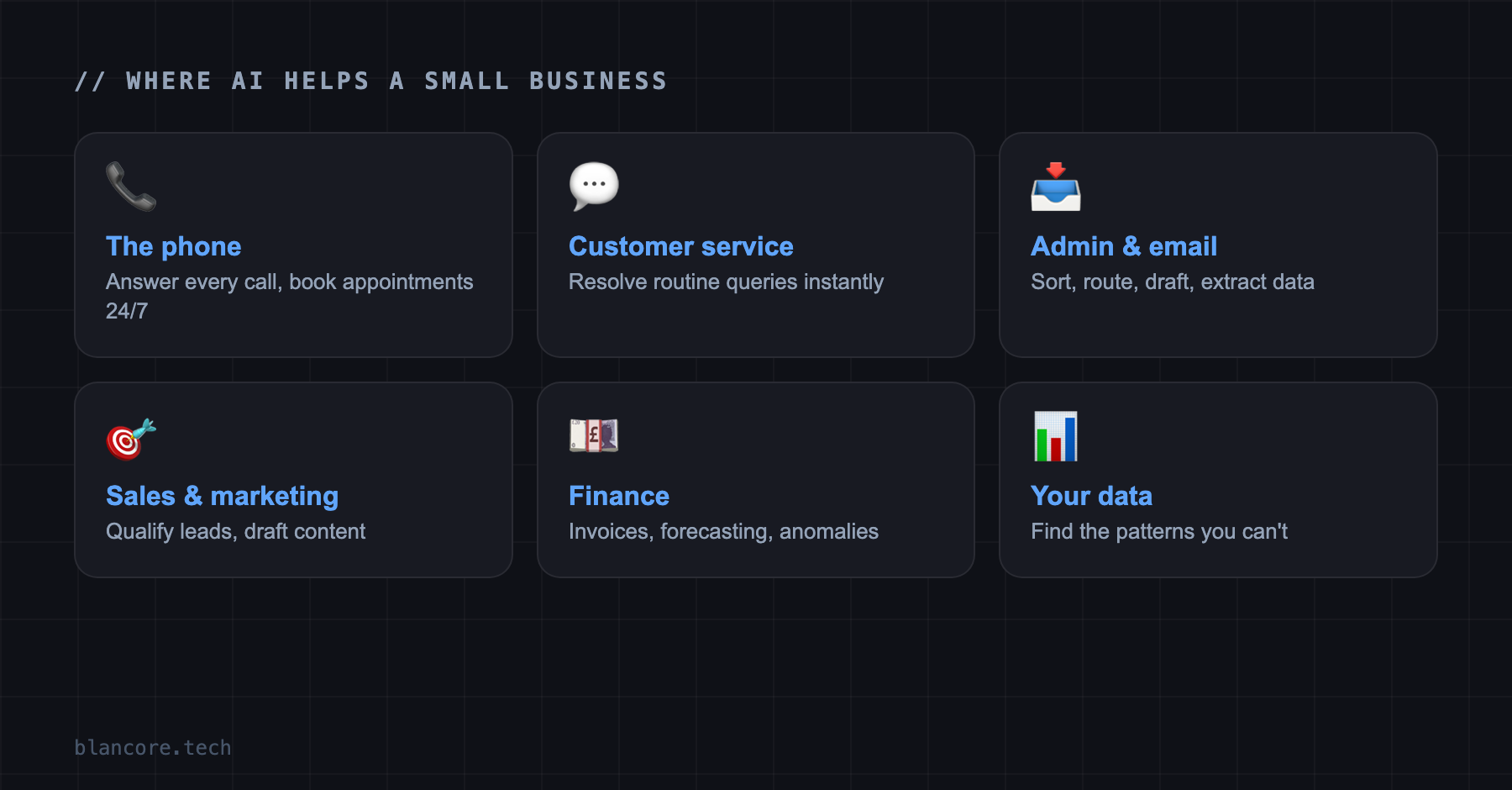
- Answer the phone 24/7. An AI phone agent picks up every call, answers common questions, and books appointments — so you stop losing business to missed calls.
- Handle first-line customer service. A chatbot or assistant resolves routine queries (opening hours, order status, "do you do X?") instantly, and passes the tricky ones to a human.
- Sort and route incoming email. AI reads, categorises and prioritises your inbox, flagging what's urgent and drafting standard replies.
- Draft content fast. Product descriptions, newsletters, social posts, website copy — AI produces a solid first draft in seconds for you to refine.
- Qualify and follow up leads. AI scores enquiries against your ideal customer and drafts personalised follow-ups, so no lead goes cold.
- Cut the admin. Processing invoices, extracting data from documents, updating records — the copy-and-paste work disappears.
- Make sense of your data. AI surfaces patterns in your sales and customer data that you'd never have time to find by hand.
- Take notes and follow actions. AI joins meetings, transcribes them, and writes the action list straight into your systems.
- Forecast and flag problems. From cash-flow projections to spotting a duplicate invoice, AI watches the numbers so you don't have to.
- Connect your tools. Wired into your existing software, AI moves information where it needs to go automatically — the end of re-typing the same thing three times.
Is it actually worth it?
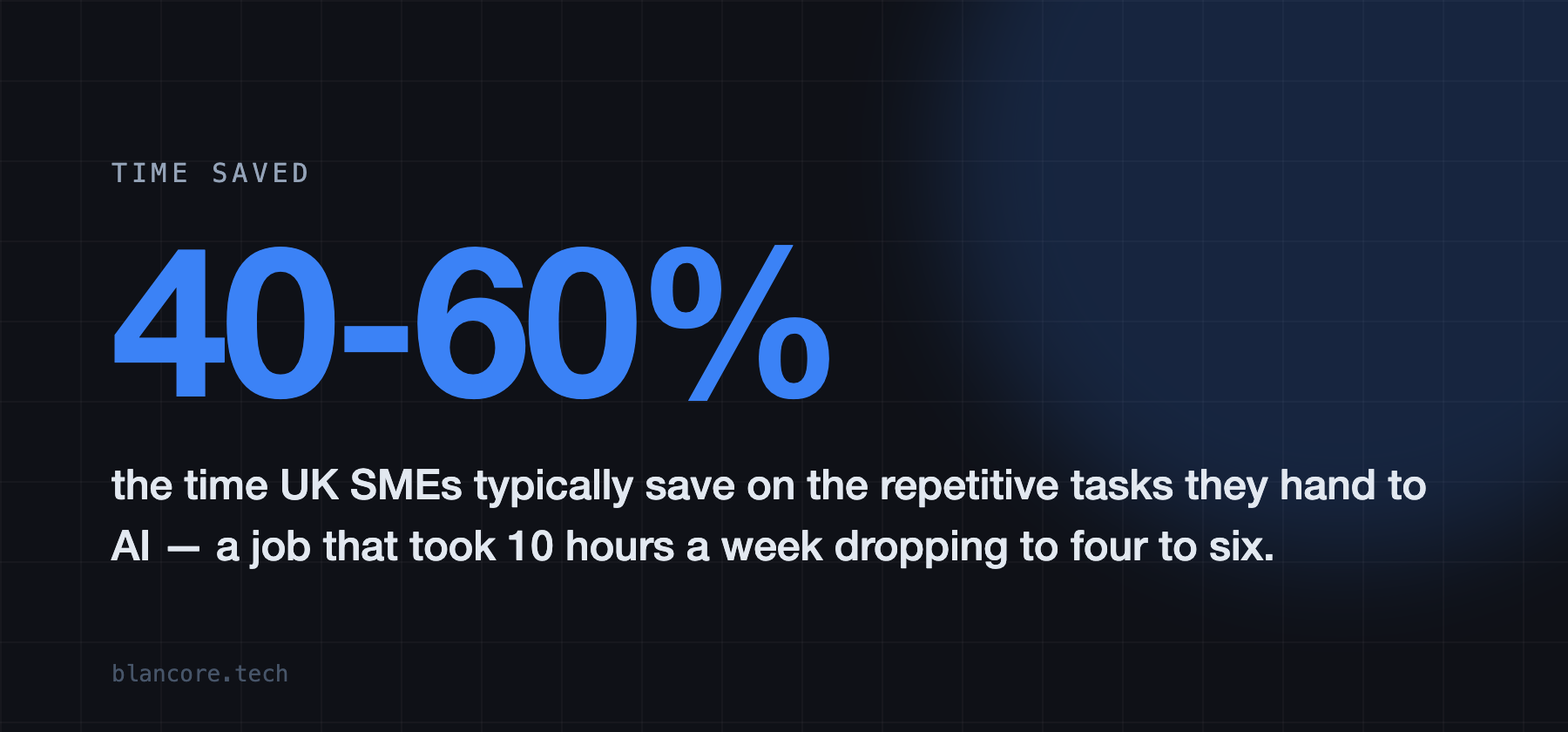
For most small businesses, yes — provided you aim it at a real task rather than adopting "AI" as a vague ambition. UK adoption has climbed sharply, and businesses that use it typically report meaningful time savings on the repetitive work they hand over — commonly 40–60% on the tasks they automate.
The businesses that win with AI don't do everything at once. They pick one high-friction task, prove it saves time or money, and expand from there.
Where should you start?
Ask one question: which task costs me the most time or the most lost business? If it's missed calls, start with a phone agent (our free missed-call cost calculator shows what those are costing you). If it's admin drowning your team, start with automation. If your tools don't talk to each other, start with integration. Pick the one that hurts most, prove it works small, then build on it.
You don't need technical skills or a big budget to begin — many tools are built for non-technical users, and tailored solutions start with a small, fixed-price pilot so you measure the return before committing. For a step-by-step approach, see our guide to automating your business with AI.

Sources & further reading
Adoption figures are from the ONS; time-saving figures reflect widely-reported UK industry surveys and are indicative. Start from your own biggest bottleneck rather than a general figure.
Frequently asked questions
Keep reading
Have a project in mind?
Tell us what you're trying to solve and we'll come back within 24 hours — no hard sell.
Start a Conversation