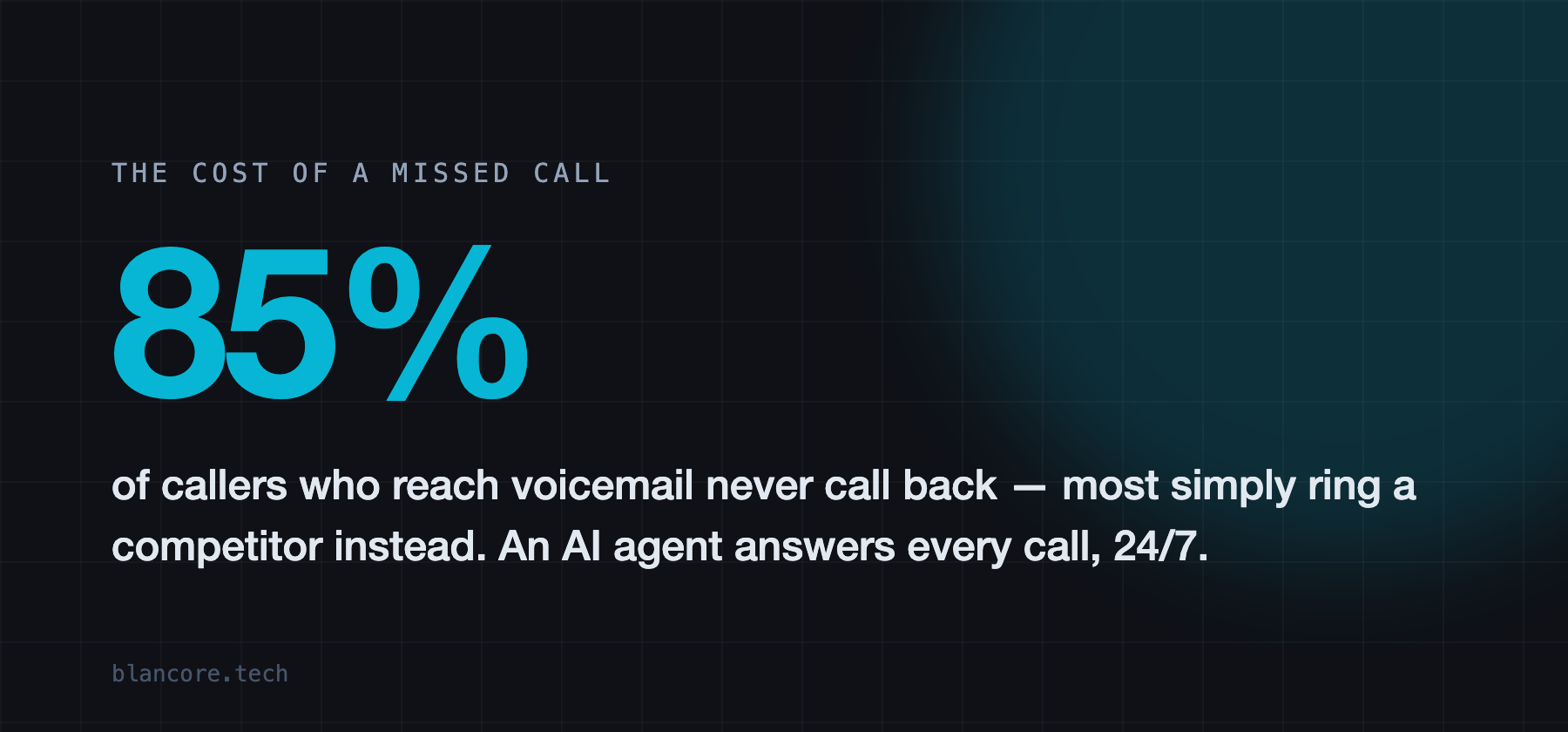
A ringing phone that nobody answers is a customer walking to your competitor. For years the only fixes were hiring more staff or paying a message-taking service. Now there's a third option that actually holds a conversation: the AI phone agent. Here's what it really does, what it costs, and how to tell whether one fits your business.
What an AI receptionist actually does
An AI receptionist is a voice AI that answers your business line the way a good human receptionist would — but every time, around the clock, on the number you already use. It isn't a press-1-for-sales menu. It listens, understands plain speech, and can:
- Greet callers and answer your common questions (opening hours, services, prices, directions).
- Qualify an enquiry — ask the right questions and capture the caller's details.
- Book, move or cancel appointments straight into your calendar.
- Take a message and send it to you instantly by email or text.
- Hand over to a real person — by live transfer or callback — the moment a call needs one.
The technology has crossed a quality threshold in the last couple of years: modern agents handle interruptions, cope with regional accents, and respond fast enough to feel like a normal conversation. This is the same capability behind our AI phone agents service — and the honest way to judge it is to hear one, which you can do in a moment.
AI agent vs human vs answering service
None of these is "best" in the abstract — they're best at different things. The trick is matching them to how your calls actually behave.
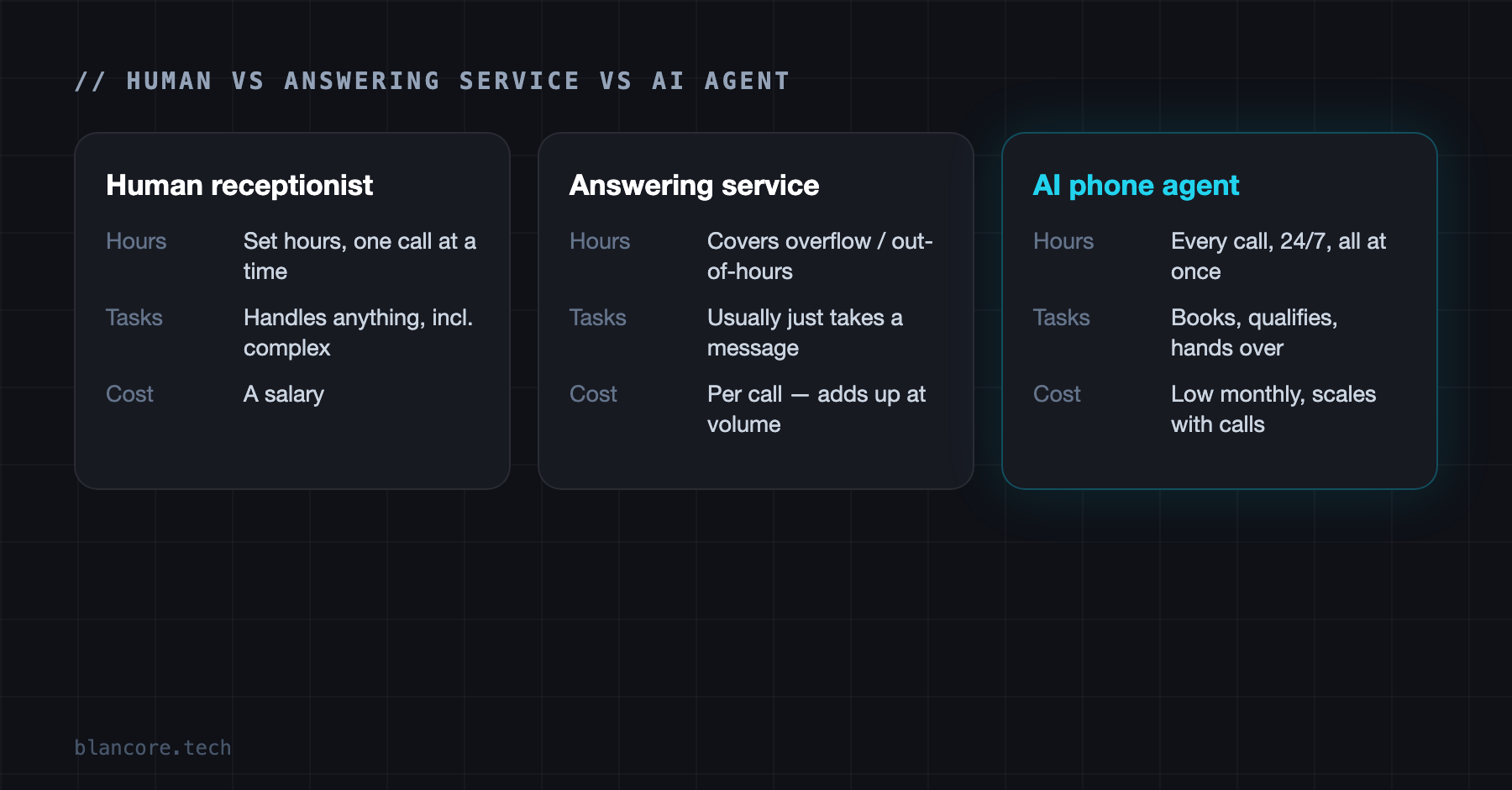
A human receptionist is unbeatable for complex, sensitive or high-value conversations — but they cost a salary, work set hours, and can only take one call at a time. A traditional answering service is cheaper and covers overflow, but usually just takes a message; it rarely completes the task. An AI agent answers every call at once, 24/7, at a fraction of the cost — and unlike a message service it can actually finish the job (book the slot, log the lead). What it isn't built for is the delicate, judgement-heavy call, which is exactly when it should hand over to a person.
In practice most businesses don't pick one. They put the AI on first-line and out-of-hours calls, and keep humans for the conversations that need them.
What does an AI phone agent cost?
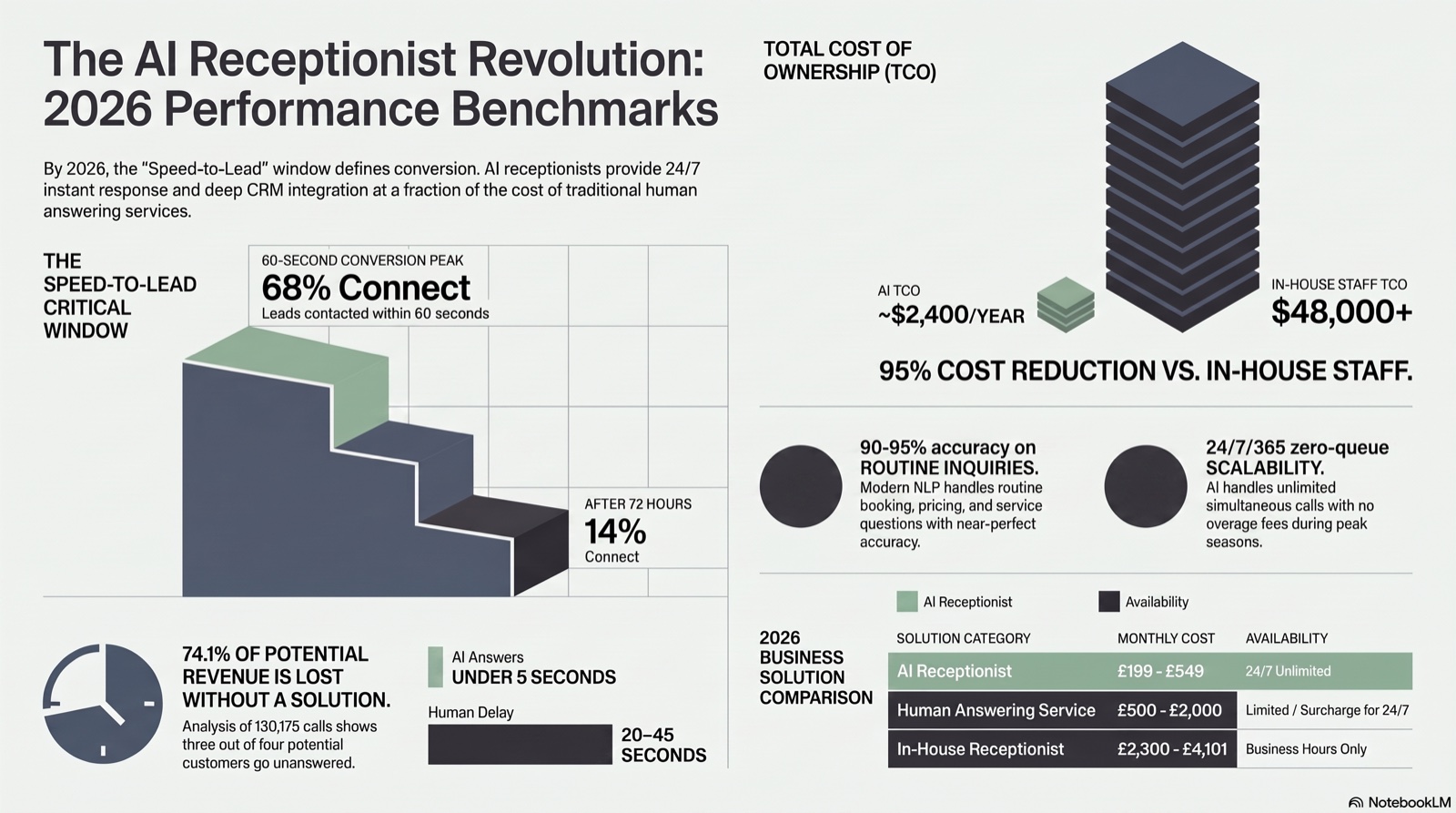
Pricing is usually a one-off setup fee — for designing the call flows, the voice, and the integrations into your calendar and CRM — plus a monthly fee that scales with how many calls it handles. The useful comparison isn't the sticker price; it's the alternative. A part-time receptionist is a salary. A human answering service charges per call, which adds up fast at volume. For most UK businesses an AI agent lands well below both once the phone is genuinely busy — while never missing a call.
The number that actually matters is what missed calls are already costing you. That's usually bigger than people expect, and it's the quickest way to see whether an agent pays for itself — our free missed-call cost calculator works it out from your own figures in a minute.
Will it sound like a robot?
Don't take anyone's word for it — including ours. Call the live demo and judge the quality yourself before you spend a penny.
Most callers can't tell a modern voice agent from a helpful human, but the only test that counts is your own ears. You can ring a production AI agent right now on the number on our AI phone agents page and put it through its paces.
Is AI phone answering allowed in the UK?
Yes — with the right handling. A proper UK deployment is built around UK GDPR and the PECR rules that govern calls: callers are informed appropriately, recording consent is handled correctly, and data is stored and kept to agreed terms. This is where vendor choice matters most. Plenty of impressive platforms are US-built and quietly fall short of UK data-residency and Ofcom requirements, so vet any provider hard on compliance and on their ability to log auditable records of every call.
Is one right for your business?
An AI phone agent earns its keep fastest if you miss calls you'd rather not, take lots of similar routine calls, want cover outside 9-to-5, or lose business when lines are busy. If your calls are few and always complex, a human is still the better answer. If you're somewhere in between — as most businesses are — the sensible move is a small pilot: put the agent on out-of-hours or overflow first, measure what it captures, then expand.
That "prove it small, then scale" approach is the same one we recommend across all our AI work, and it's covered in our guide to automating your business with AI. Voice is simply one of the highest-return places to start.
Sources & further reading
The 85% figure is widely reported in phone-answering industry research; cost and capability points reflect current UK voice-AI practice and are indicative — confirm figures for your own call volume. For the rules that apply to calls and personal data, see the ICO and Ofcom.
Frequently asked questions
Keep reading
Have a project in mind?
Tell us what you're trying to solve and we'll come back within 24 hours — no hard sell.
Start a Conversation