
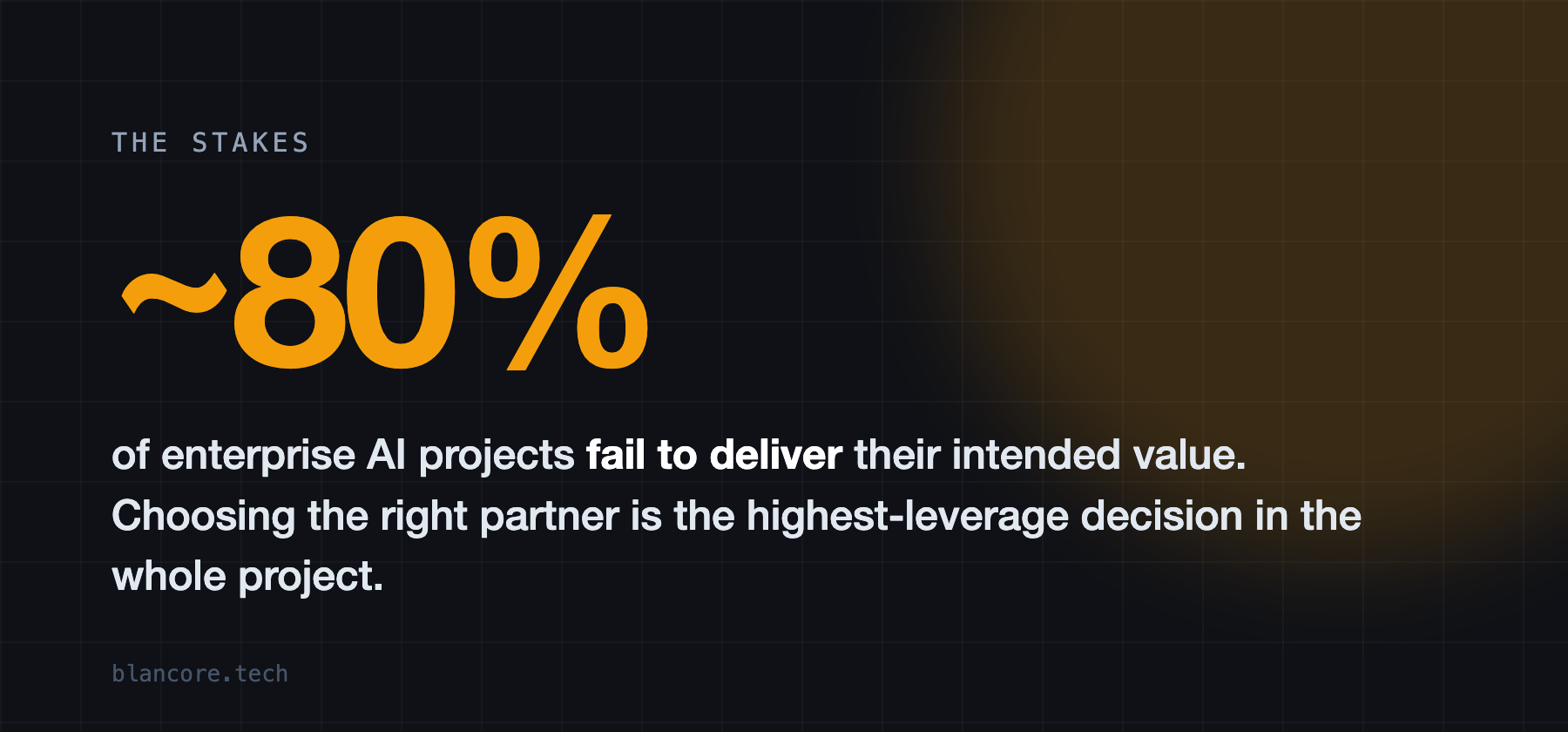
Picking the wrong AI partner is one of the most expensive mistakes a UK business can make right now. Industry analyses repeatedly estimate that around 80% of enterprise AI projects fail to deliver their intended business value — usually not because the technology couldn't work, but because the wrong partner built the wrong thing, on shaky data, with no plan for what happens after launch.
The good news: the agencies that consistently deliver are easy to spot once you know what to look for. This guide walks through the criteria that actually matter, the questions that separate real engineers from resellers, and the red flags worth walking away from.
Start with the outcome, not the technology
The single best signal of a good AI agency is what they talk about first. A capable partner opens by trying to understand your business problem and the numbers you want to move — hours saved, response times, conversion rate, error rates. A weaker one leads with technology: "we build on this model", "we do this framework". If an agency is selling you a tool before they understand your bottleneck, they're selling a solution in search of a problem.
Everything good flows from this. At BLANCORE every engagement starts with a free consultation that scopes the actual problem before anyone writes code — it's the same principle behind our AI integration work: the simplest thing that delivers the result, not the most impressive demo.
The criteria that matter
1. A real production track record
Anyone can build a slick demo. Far fewer have run live AI systems at scale, handling the messy edge cases that only appear in production. Ask to see something they've actually shipped — ideally in a business like yours — and, where possible, ask to speak to the client who uses it.
2. Rigorous data readiness
AI is only as good as the data feeding it. A serious agency audits the quality and accessibility of your data before proposing an architecture. If they recommend a model without ever asking to see a sample of your real data or discussing how to fix fragmented records, that's a red flag.
3. UK GDPR fluency and governance
Data protection is non-negotiable for UK businesses. Your partner should be fluent in UK GDPR, clear about where data is processed and stored, and able to keep processing within UK or EU regions when your sector requires it. Independent certifications such as ISO 27001 (and, increasingly, ISO/IEC 42001 for AI management) are a strong signal that governance is taken seriously rather than bolted on.
4. Clear ownership of code and IP
Your contract should state plainly that you own the code, the trained models, your input data, and the outputs. Ambiguous IP terms are a leading cause of vendor lock-in and legal disputes. A trustworthy agency hands you everything at the end — no hostage-taking.
5. A post-launch plan
AI projects don't end at deployment. Models drift, data changes, and knowledge bases go stale. Ask how they'll monitor accuracy and catch regressions six months in. If there's no concrete support arrangement, they're treating AI like fire-and-forget software — which is exactly how accuracy quietly degrades.
6. Transparent, honest pricing
Insist on a full cost breakdown: the build, cloud infrastructure, ongoing model/API usage, and maintenance. The healthiest way to start is a small fixed-price pilot so you can measure the return before committing to a full build. Some agencies also offer outcome-based pricing, where part of the fee is tied to hitting the target metric — a good sign their incentives are aligned with yours.
7. Integration, not just intelligence
AI that isn't wired into the software your team already uses rarely delivers value. The best partners treat AI as one capability inside solid software engineering — able to build the model and connect it to your CRM, phone system, or finance tools. That's why our own work spans systems integration, app development, and bespoke software alongside AI, rather than AI in isolation.
The questions that reveal the truth
You'll learn more from five pointed questions than from any sales deck. Ask:
- "Who owns the code and data when we're done?" — the answer should be an immediate, unambiguous "you do".
- "How do you handle UK GDPR and where is our data processed?" — vagueness here is disqualifying.
- "Can we start with a small paid pilot before committing to the full build?" — a confident partner welcomes this.
- "Who exactly will build this?" — a common tactic is to pitch with senior experts, then hand delivery to juniors. Ask for the actual team and to be told before anyone is swapped.
- "What happens when the AI gets something wrong?" — good answers cover fallback logic, human-in-the-loop checks, and how they mitigate hallucinations. Nobody honest promises 100%.
Red flags to walk away from
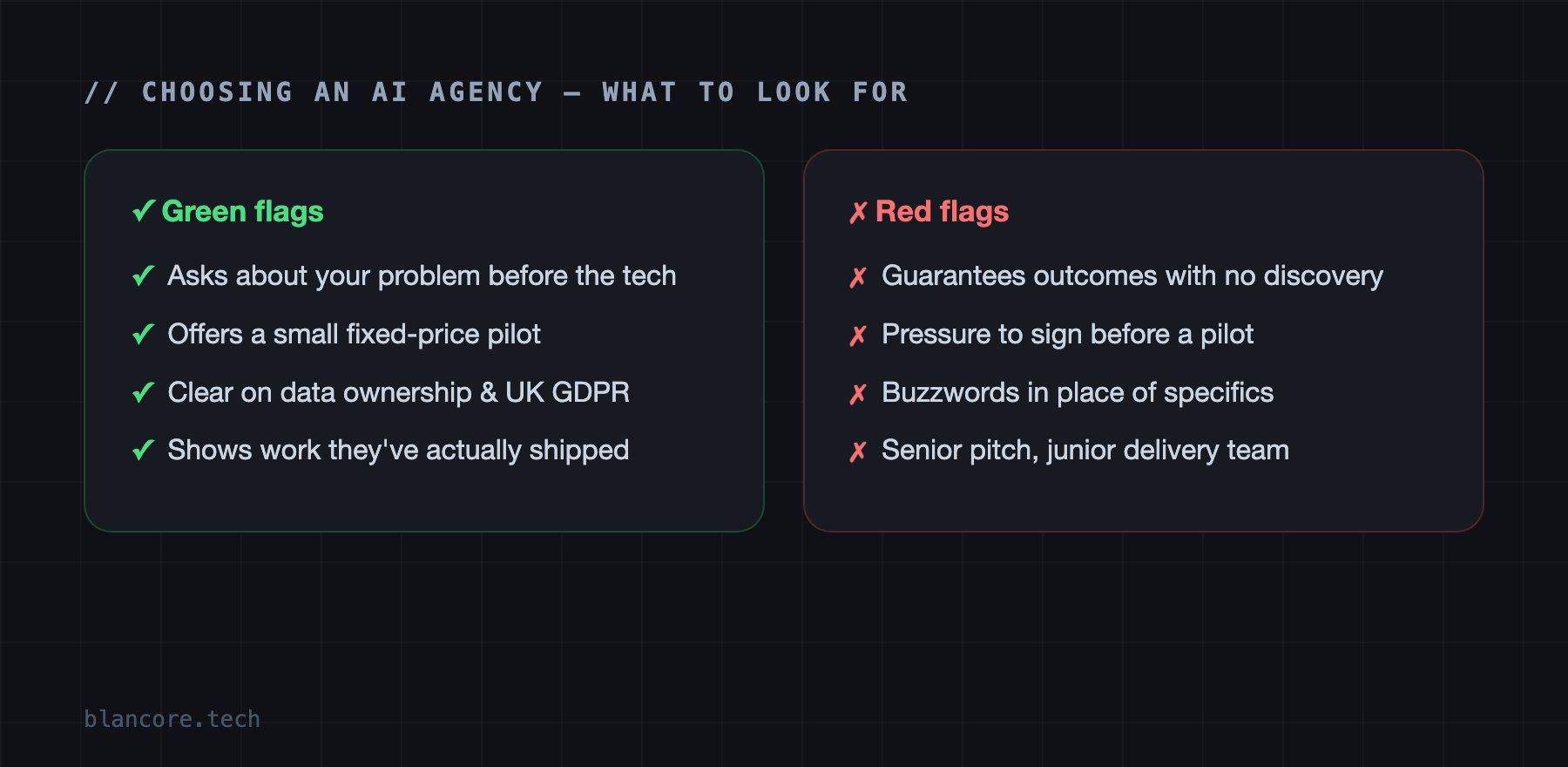
Guaranteed outcomes with no discovery, pressure to sign before a pilot, no clear answer on data ownership or GDPR, buzzwords in place of specifics, and no examples of shipped work. Any one of these is a reason to slow down.
The bait-and-switch team is especially common: impressive names on the call, junior developers on the keyboard. So is the agency that quotes a large figure before understanding your workflow. Trust the partner who scopes a small, measurable first step over the one who promises the moon on day one.
A sensible way to start
You don't have to get the whole decision right at once. Shortlist two or three agencies, give each the same small, well-defined problem, and ask for a fixed-price pilot proposal. The proposals themselves — how they scope, what they ask about your data, how they talk about risk — will tell you who to trust with the bigger work.
If AI phone handling is on your list, it's worth quantifying the problem first: our free missed-call cost calculator shows what unanswered calls are costing you, which makes any pilot easy to justify.
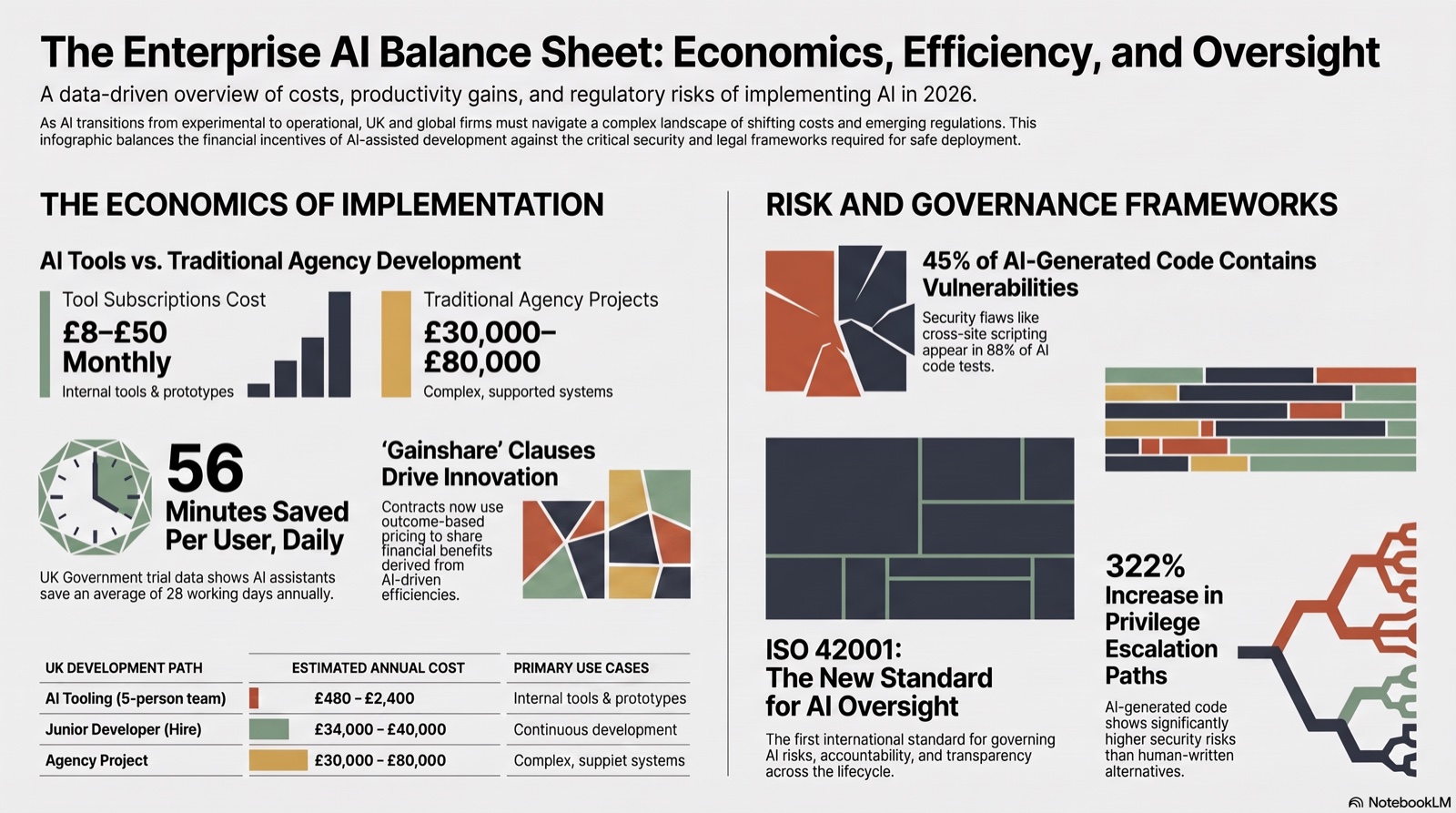
Sources & further reading
Project-outcome figures are drawn from the industry research below; where a number comes from surveys rather than official data, we've flagged it in the text. Confirm current obligations for your sector before acting.
Frequently asked questions
Keep reading
Have a project in mind?
Tell us what you're trying to solve and we'll come back within 24 hours — no hard sell.
Start a Conversation