
The hard part is no longer working out whether AI can do a job. It usually can. The hard part is deciding which job to hand over first — because doing them in the wrong order is how AI projects quietly stall. Here is a way to rank the work in your own business, using two questions and about five minutes.
"Start small" is useless advice on its own
Everyone says it. Nobody says which small thing, and that is the entire question. Start with the wrong small thing and you spend three months automating the weekly report nobody reads, prove very little, and lose the room. Start with the right one and the next project funds itself.
Once you know how the work gets done — which is a separate article — the only question left is order. And order comes down to two things.
The two questions that rank anything
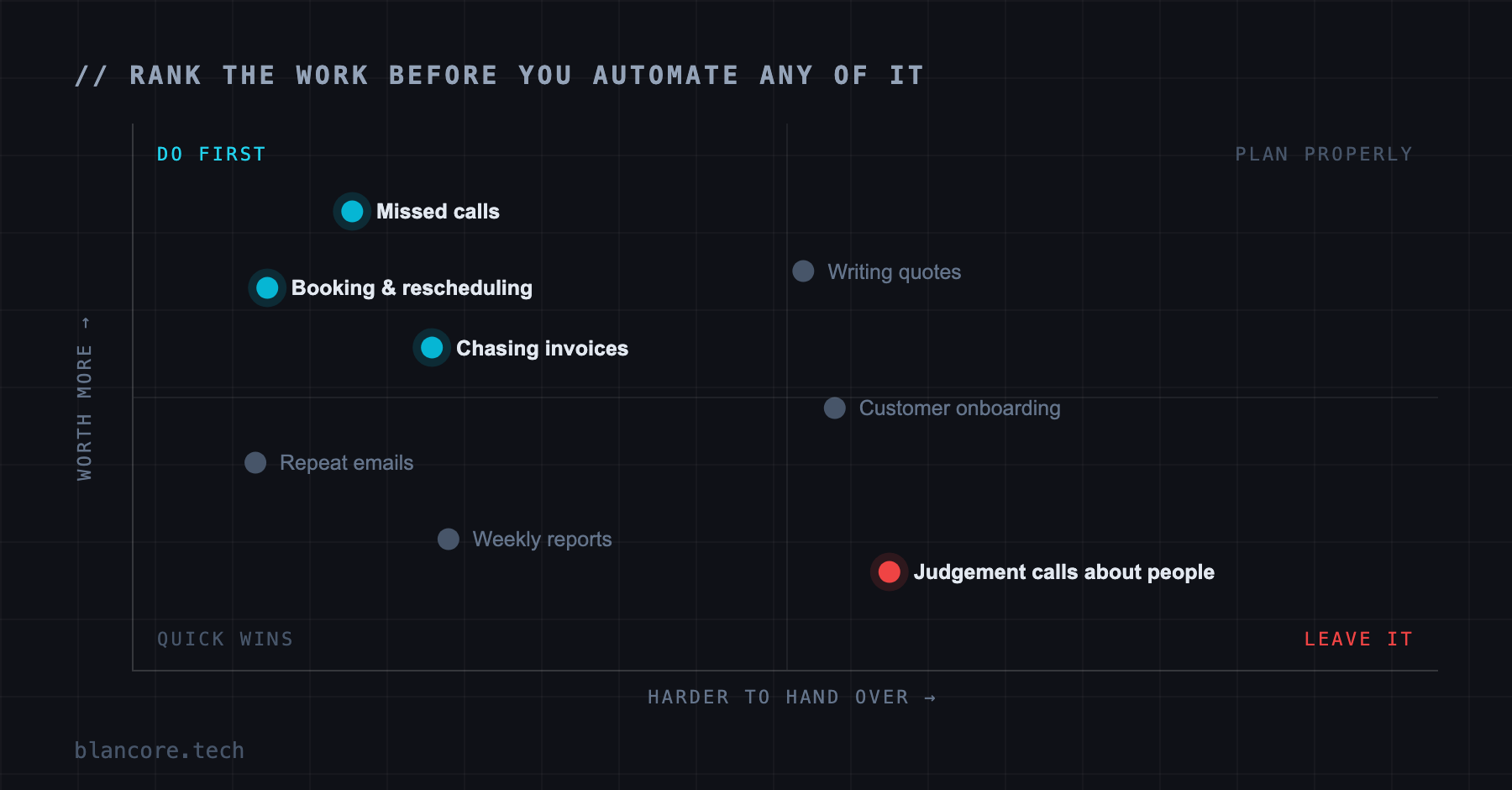
One: what is it worth to get this off your plate? Not hours — consequences. An hour spent on the weekly report costs you an hour. An hour of unanswered phone is a customer who rang someone else. Those are not the same hour, and treating them as the same is why so many businesses automate the wrong thing first.
Two: how hard is it to hand over? A job is easy to hand over when the rules are already written down somewhere, and hard when they live in someone's head. "Answer this common question" is easy. "Price this job" is hard — not technically, but because nobody has ever written down how the pricing actually works.
The four quadrants
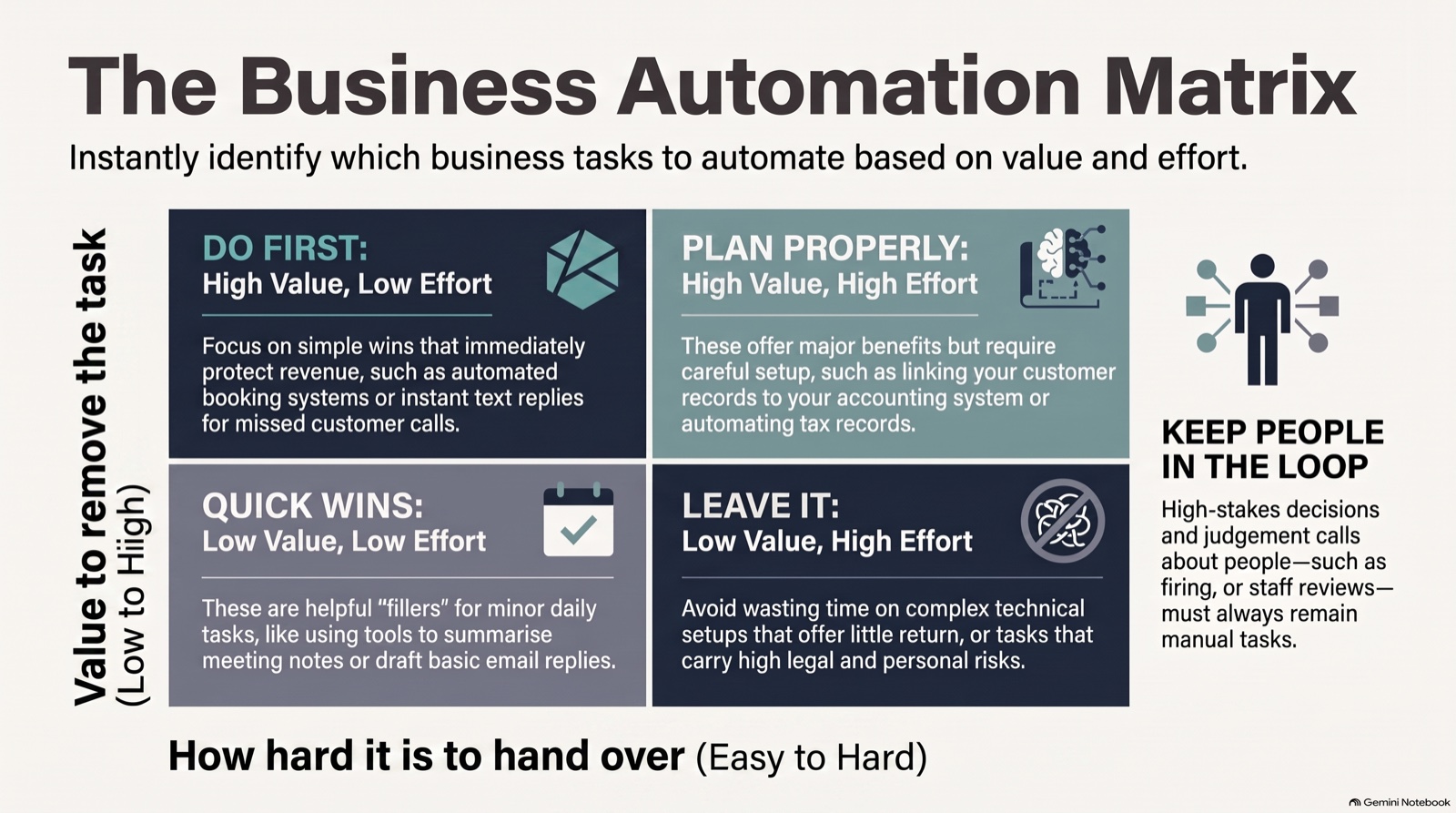
Plot the two against each other and you get four groups, and each has a different instruction:
- Do first — worth a lot, easy to hand over. Start here, always.
- Plan properly — worth a lot, but genuinely hard. Real projects. Worth doing second, not first.
- Quick wins — easy but not worth much. Fine as a warm-up, dangerous as a strategy.
- Leave it — hard and not worth much. There is always at least one of these, and the discipline is to say so out loud.
Where do your jobs land?
Tap the ones you recognise. The order underneath is what we would actually tackle them in.
Which of these eats your week?
Tap every job you recognise. They plot by how much they're worth against how hard they are to hand over — and the order to tackle them in appears underneath.
The most expensive job on this list, because a missed call is usually a lost customer rather than a delayed one. Work out what it is costing you with the missed-call calculator, then see AI Phone Agents. Once that is running and you trust it, move to answering the same email questions. And leave the judgement calls to a person — AI that bluffs its way through one of those costs far more than the time it saved.
The positions are our own rule of thumb from UK SME projects, not measured data — use them to order the conversation, not to settle it.
Where most UK businesses should start
In our experience it is almost always one of two things: the calls nobody gets to, or the same question answered forty times a week.
The phone wins on value. A missed call is rarely a delayed sale — it is usually a lost one, because the caller rings the next firm on the list and never mentions it. That is why it sits top-right of almost every list we build. If you have never put a number on it, our free missed-call cost calculator does it from your own figures in about a minute, and the number is usually larger than people expect.
Repeat questions win on ease. They are the safest possible place to learn what AI gets wrong, because the cost of a mistake is a slightly odd email rather than a lost customer. Several businesses we work with start here deliberately, purely to build confidence before pointing anything at the phone.
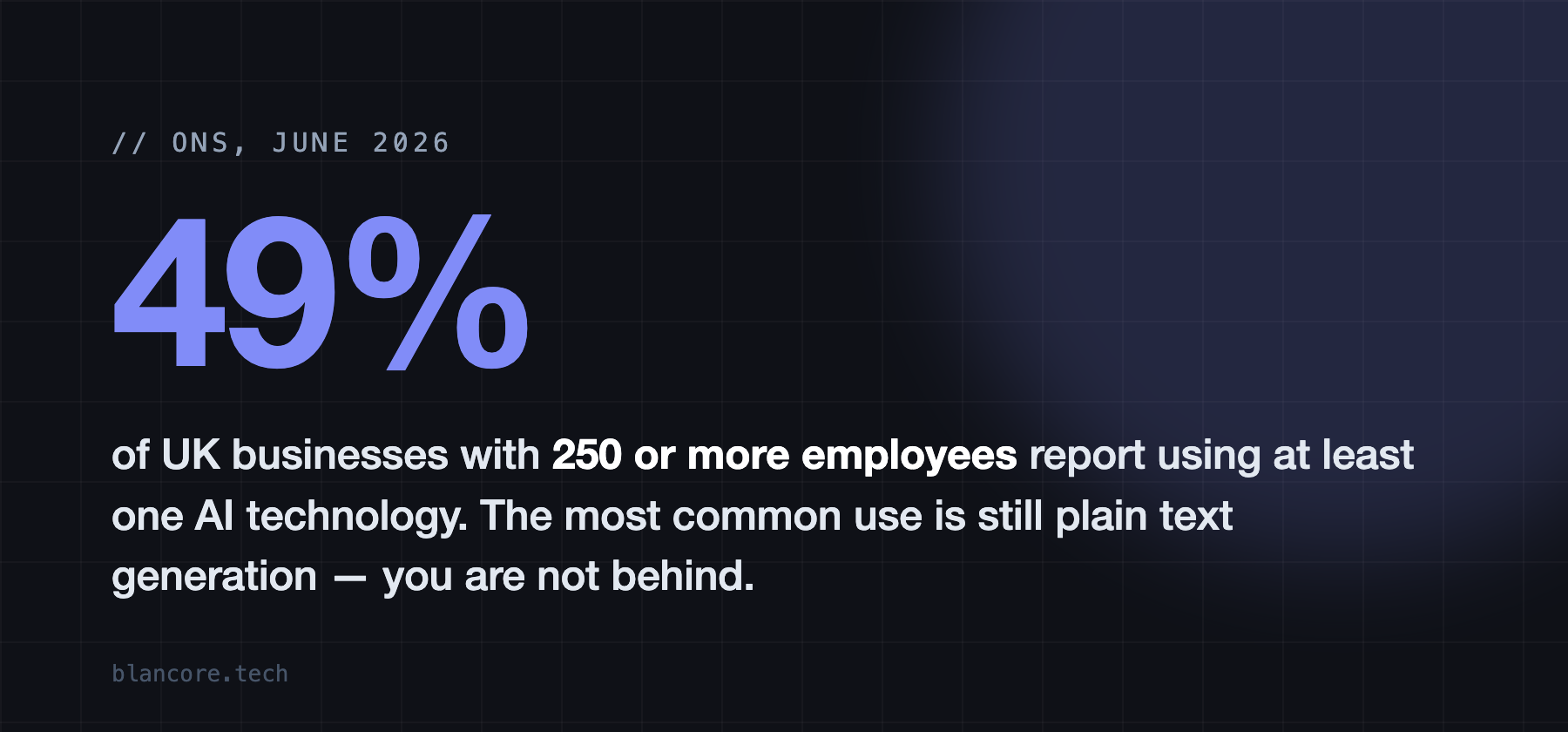
It is worth noting how ordinary the mainstream still is: ONS figures for June 2026 put AI use at around half of businesses with 250 or more employees, and the most common use by some distance is still plain text generation with a large language model — under a fifth of businesses overall. Almost nobody is doing anything exotic. You are not behind.
The one job to leave alone
Anything that requires a judgement call about a person. Hiring decisions, complaints, the customer having a genuinely bad week. These sit bottom-right for a reason: hard to do well, low reward when it works, and real damage when it doesn't.
An AI that bluffs its way through a difficult human conversation costs far more than the time it saved. Route those to a person — and build the handover deliberately, rather than hoping it never comes up.
A good supplier will tell you which of your jobs belongs in that quadrant. If everything on your list comes back as a great fit for AI, you are talking to someone selling AI rather than solving your problem.
A sensible first ninety days
Pick the top item. Just one. Run it for a month against a number you agreed in advance — calls answered, hours returned, response time — and be willing to stop if the number doesn't move. Then take the second.
Two things reliably derail this. The first is starting three at once, so nothing gets the attention to work properly. The second is discovering halfway through that the data lives in two systems that don't talk, which turns a four-week job into a four-month one — worth checking before you start, and usually a systems integration job rather than an AI one.
If you would rather have someone walk the list with you and say plainly which items are worth it, that is where our AI solutions work begins. And if you are still at the "what could this even do for us" stage, start with ten practical ways AI helps a small business instead.
Sources & further reading
Adoption figures are from the ONS Business Insights and Conditions Survey (Wave 159, June 2026). The value-versus-effort positions in the tool above are our own rule of thumb from UK SME projects, not measured data.
Frequently asked questions
Keep reading
Have a project in mind?
Tell us what you're trying to solve and we'll come back within 24 hours — no hard sell.
Start a Conversation